

Chemical Engineering, BSE
Explore how raw materials can be transformed into innovations that shape a better world. You'll explore the chemistry and engineering behind breakthrough pharmaceuticals, advanced materials and sustainable technologies. Gain the knowledge and skills to optimize industrial processes, develop cleaner energy solutions and address global challenges through research-driven chemical design.
Quick facts

Locations


Courses


Degree description
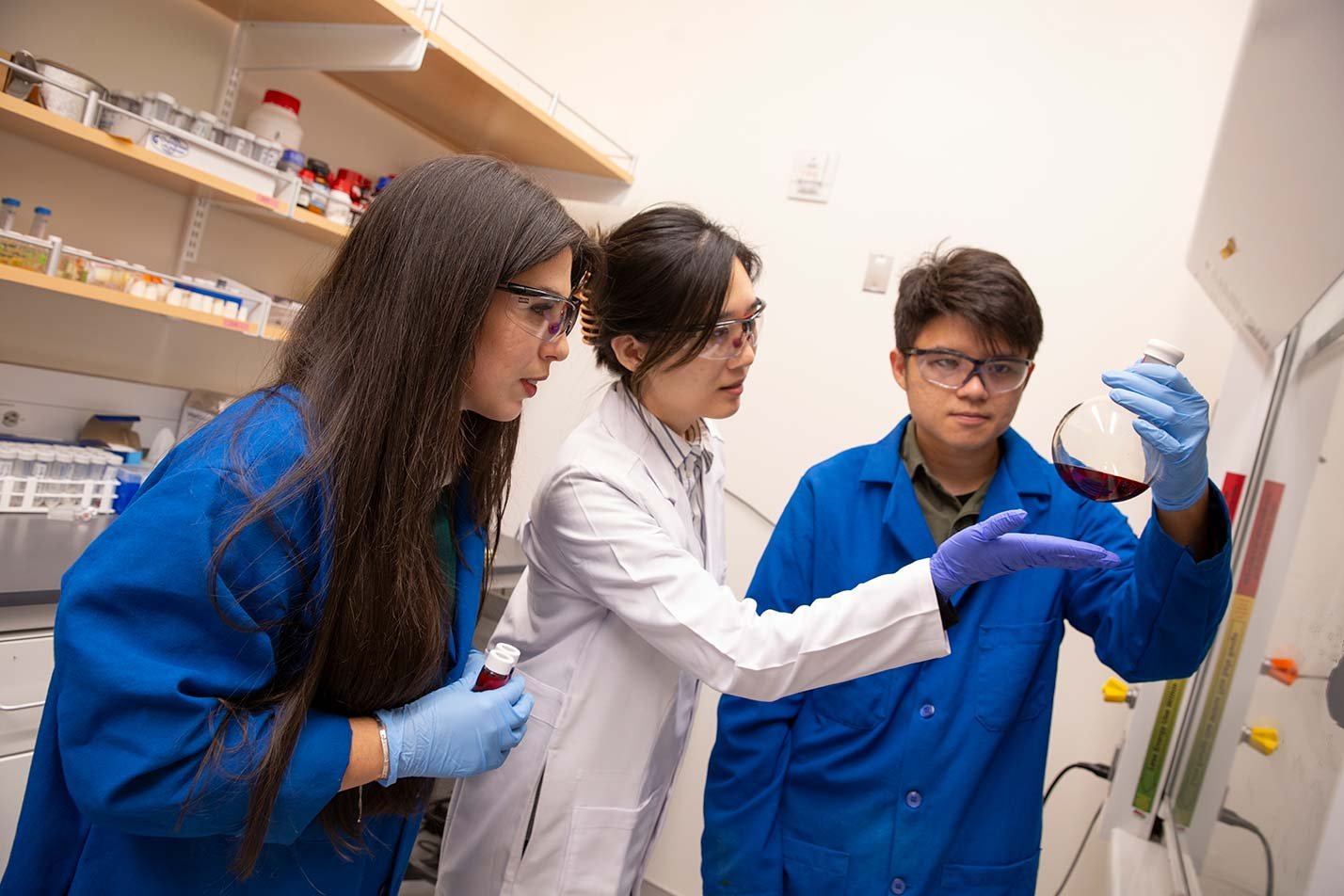
Chemical engineering deals with the application of chemistry, physics and mathematics to the process of converting raw materials or chemicals into more useful or valuable forms. Chemical engineering also involves the design of valuable new materials and chemical products. The modern discipline of chemical engineering is intertwined with biology and biomedical engineering.
In the Bachelor of Science in Engineering program in chemical engineering, you build on a broad base of knowledge within the basic and mathematical sciences and engineering.
Accredited by the Engineering Accreditation Commission of ABET, https://www.abet.org/, under the General Criteria and the Chemical, Biochemical, Biomolecular Engineering Program Criteria.
Courses
Explore a sample list of courses you may take in this program.
| Sample courses |
|---|
| CHE 211 Introduction to Chemical Processing |
| CHE 231 Introduction to Transport Phenomena I: Fluids |
| FSE 100 Introduction to Engineering |
| CHE 334 Introduction to Transport Phenomena II: Heat and Mass Transfer |
| CHE 342 Introduction to Applied Chemical Thermodynamics |
| CHE 352 Chemical Engineering Lab I |

Course checksheet and curriculum archive
The curriculum checksheet displays this program's required courses and other requirements you must complete for graduation.
Current ASU students, see how your courses can apply to another major and find out how to change your major (opens in new window).


Already completed some college courses? Build on your success.
If you earned college credit outside ASU, our transfer tools map out your progress towards a degree and help you plan next steps.
See how your credits may apply (opens in new window)What you'll learn
The following learning outcomes highlight some of the knowledge and skills you'll develop to support your future success.
- Apply key principles in engineering and applied chemistry through chemical process design.
- Demonstrate the ability to effectively communicate in written and oral methods in student assignments including an oral project defense and lab report.
- Apply fundamental knowledge of mathematics, science, and engineering to complex chemical engineering problems.
 Apply key principles in engineering and applied chemistry through chemical process design.
Admission requirements
Here are the admission and application details
All students are required to meet general university admission requirements.
First year (opens in new window) | Transfer (opens in new window) | International (opens in new window) | Readmission (opens in new window)
The admission standards for majors in the Ira A. Fulton Schools of Engineering, shown below, are higher than minimum university admission standards. International students must meet the same admission standards, with the possible additional requirement of a minimum English language proficiency test score. If the university requires an English proficiency test score from the applicant, then admission to engineering requires requires a minimum total TOEFL iBT® score of 4 with a minimum section score of 3.5 (Reading: 3.5, Writing: 3.5, Listening: 3.5, Speaking: 3.5), or a score of 79 (taken at a testing center) if taken before Jan. 21, 2026; or a minimum IELTS score of 6.5; a minimum PTE score of 58; a minimum Duolingo English score of 105; or a minimum Cambridge English exam score of 176. First-year admission:
Transfer admission requirements:
Transfer students with fewer than 24 transferable college credit hours: Transfer students with 24 or more transferable college credit hours must meet EITHER the primary or the secondary criteria (not both): Primary criteria Secondary criteria
Admission requirements for many majors in the Ira A. Fulton Schools of Engineering are higher than university admission standards.
Students should visit the Change of Major form (opens in new window) for information about how to change a major to this program.
Explore expanded study opportunities
This program allows you to obtain both a bachelor's and a master's degree in as little as five years. As a high-achieving student, accelerated bachelor's plus master's degree programs are designed for you to share undergraduate coursework with graduate coursework to accelerate completion of your master's degree. These programs feature the same high-quality curriculum taught by ASU's world-renowned faculty.
This program is offered as an accelerated bachelor's plus master's degree with:
Approval to pursue the accelerated master's is typically granted during the junior year of your bachelor's degree program. If you are interested, you can learn more about eligibility requirements and how to apply.
When you pursue concurrent degrees (also known as a “double major”), you earn two distinct degrees and receive two diplomas. Working with your academic advisor, you can create your own concurrent degree combination. Some combinations are not possible due to high levels of overlap in curriculum.
Global Education programs give students an important opportunity to develop valuable skills and have experiences that help to grow their self-confidence and enable them to develop their communication skills, giving them an advantage.
Students learn intercultural applications of design and technology skills through hands-on learning and cultural engagement opportunities in an international setting. Participation in a Global Education program exposes students to unique environments and cultures, challenges them to adapt and persevere, helps them increase their professional and educational networks, and enhances their portfolio of experience through the kinds of hands-on research and community-based opportunities they need to compete and succeed in today's challenging and quickly changing STEM fields.
The Ira A. Fulton Schools of Engineering recommends these programs for students majoring in chemical engineering.


Paying for college
Use our calculator to estimate your full-time or part-time tuition fees for this program prior to any financial aid. Keep in mind that most of our students receive financial aid, which can reduce out-of-pocket costs.
Get an estimate


Build the career and future you want
Our graduates are prepared for a variety of career paths, including:
| Career | Growth | Median Salary | More Information |
|---|---|---|---|
| Biofuel Development Manager | 5.5% | $171,270 | Learn more |
| Biomedical Engineer | 7.6% | $109,370 | Learn more |
| Chemical Engineer | 4.7% | $125,040 | Learn more |
| Chemist | 6.4% | $91,240 | Learn more |
| Fuel Cell Engineer | 11.2% | $104,110 | Learn more |
| Nuclear Engineer | 0.4% | $133,970 | Learn more |
| Petroleum Engineer | 2.0% | $144,910 | Learn more |
| Pharmacist | 5.2% | $140,910 | Learn more |
Example job titles and salaries listed are not necessarily entry level, and students should take into consideration how years of experience and geographical location may affect pay scales. Some jobs also may require advanced degrees, certifications or state-specific licensure.
Data obtained from the Occupational Information Network (O*NET) under sponsorship of the U.S. Department of Labor/Employment and Training Administration (USDOL/ETA).
More about careers
Graduates are prepared for excellent career opportunities. Chemical engineers are engaged in the development and production of a diverse variety of products, including high-performance materials needed for aerospace, automotive, biomedical, electronic and environmental applications. They have traditionally played a key role in industries as varied as:
- artificial fibers
- biotechnology
- ceramics
- food
- glass
- petrochemicals
- petroleum
- plastics
- primary metals
- semiconductors
- specialty chemicals
Chemical engineering graduates are also in great demand in many newer fields, such as biomedical engineering and modern materials science (composites, superconductors), and those that center on solving environmental problems.
Contact information
Use the contact information below to get in touch if you're a current student or have general questions.
Prospective students should fill out the Request for Information form.
Chemical Engineering Program
|
USE 138
semte@asu.edu
480-965-2335
Frequently asked questions about degree programs
Accelerated programs allow students the opportunity to expedite the completion of their degree.
Accelerated master's
These programs allow students to accelerate their studies to earn a bachelor's plus a master's degree in as few as five years (for some programs).
Each program has requirements students must meet to be eligible for consideration. Students typically receive approval to pursue the accelerated master's during the junior year of their bachelor's degree program. Interested students can learn about eligibility requirements and how to apply.
Concurrent degrees allow students to pursue their own personal or professional interests, earn two distinct degrees and receive two diplomas. To add a concurrent degree to your existing degree, work with your academic advisor.
Joint programs, or jointly conferred degrees, are offered by more than one college and provide opportunities for students to take advantage of the academic strengths of two academic units. Upon graduation, students are awarded one degree and one diploma conferred by two colleges.
ASU adds new programs to Degree Search frequently. Come back often and look for the "New Programs" option.
ASU Online offers programs in an entirely online format with multiple enrollment sessions throughout the year. See https://asuonline.asu.edu/ for more information.
