

Construction Engineering, BSE
Turn your dream of shaping skylines and impacting communities into a career. Learn to bring ambitious builds to life and leave a lasting mark on the places people live and work.
Quick facts

Locations


Courses


Degree description
Construction Engineering degree description
In the Bachelor of Science in Engineering program in construction engineering, you gain a professional engineering license while working at the interface of design and construction. The program prepares you for a career that emphasizes the construction of infrastructure.
The degree program's engineering design and construction management courses include a focus on sustainability and building information modeling topics. Construction management content includes construction methods, contract management, cost and schedule control, people management and project estimating.
The curriculum's design content includes structures, geotechnical engineering and transportation. You are further prepared with the computer, management, technical and people skills you need to succeed.
Program educational objectives:
The educational objectives of the construction engineering program at Arizona State University are to prepare its graduates such that three to five years after graduating, they have demonstrated in their professional practice that they can:
- Lead collaboration with professionals across the architectural/engineering/construction community to improve the project delivery process.
- Ethically engage in professional practice
- Demonstrate lifelong learning skills through certifications, professional development and registration, as appropriate. for their employers.
- Address sustainably the needs of society through the built environment.
- Successfully balance technical aspects of engineering and practical applications of construction.
- Foster respectful, collaborative and professional work environments that leverage the strengths and perspectives of multidisciplinary teams.
ABET student outcomes:
Construction engineering graduates are expected to achieve the following student outcomes by graduation:
- An ability to identify, formulate and solve complex engineering problems by applying principles of engineering, science and mathematics
- An ability to apply engineering design to produce solutions that meet specified needs with consideration of public health, safety and welfare, as well as global, cultural, social, environmental and economic factors
- An ability to communicate effectively with a range of audiences
- An ability to recognize ethical and professional responsibilities in engineering situations and make informed judgements, which must consider the impact of engineering solutions in global, economic, environmental and societal contexts
- An ability to function effectively on a team whose members together provide leadership, create a collaborative and inclusive environment, establish goals, plan tasks, and meet objectives
- An ability to develop and conduct appropriate experimentation, analyze and interpret data, and use engineering judgment to draw conclusions
- An ability to acquire and apply new knowledge as needed, using appropriate learning strategies
Printable program brochure:
Construction Engineering, BSE (PDF)
Why study construction engineering at ASU?
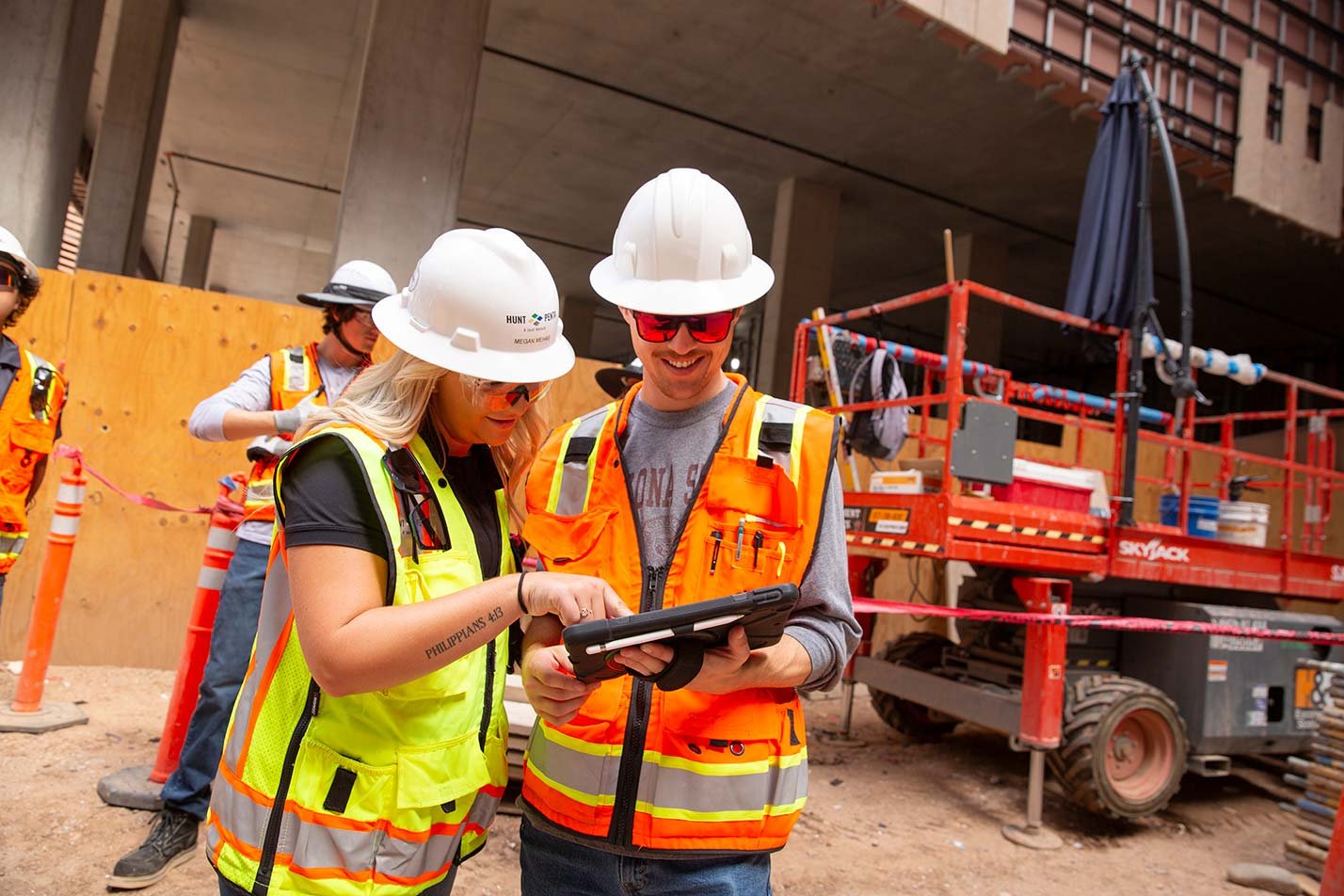
In the Del E. Webb School of Construction, you gain hands-on experience in real construction environments, learn from industry-engaged faculty, and prepare for a career at the intersection of engineering innovation and on-site execution. You complete two internships that put your classroom learning into practice.
Each semester, the school hosts career fairs and creates ways to collaborate with industry professionals through visits, professional organizations, student organization activities and competitions, the Construction Engineering Advisory Board, and scholarships and other educational support from the Industry Partner Circle. These experiences connect you with employers seeking interns and full-time hires.
Additional details
Beyond the classroom, you can get involved in the ASU North American Society for Trenchless Technology Student Chapter, the Associated Schools of Construction's Annual Student Competition, Advancing Women in Construction, Construction in Indian Country, and more than 100 engineering-focused student organizations.
Courses
Explore a sample list of courses you may take in this program.
| Sample courses |
|---|
| CNE 321 Structural Analysis and Design |
| CNE 351 Geotechnical Engineering |
| CNE 353 Civil Engineering Materials |
| CNE 383 Construction Estimating |
| CNE 453 Construction Technology |
| CNE 455 Construction Project Management |

Course checksheet and curriculum archive
The curriculum checksheet displays this program's required courses and other requirements you must complete for graduation.
Current ASU students, see how your courses can apply to another major and find out how to change your major (opens in new window).


Already completed some college courses? Build on your success.
If you earned college credit outside ASU, our transfer tools map out your progress towards a degree and help you plan next steps.
See how your credits may apply (opens in new window)Admission requirements
Here are the admission and application details
All students are required to meet general university admission requirements.
First year (opens in new window) | Transfer (opens in new window) | International (opens in new window) | Readmission (opens in new window)
The admission standards for majors in the Ira A. Fulton Schools of Engineering, shown below, are higher than minimum university admission standards. International students must meet the same admission standards, with the possible additional requirement of a minimum English language proficiency test score. If the university requires an English proficiency test score from the applicant, then admission to engineering requires requires a minimum total TOEFL iBT® score of 4 with a minimum section score of 3.5 (Reading: 3.5, Writing: 3.5, Listening: 3.5, Speaking: 3.5), or a score of 79 (taken at a testing center) if taken before Jan. 21, 2026; or a minimum IELTS score of 6.5; a minimum PTE score of 58; a minimum Duolingo English score of 105; or a minimum Cambridge English exam score of 176. First-year admission:
Transfer admission requirements:
Transfer students with fewer than 24 transferable college credit hours: Transfer students with 24 or more transferable college credit hours must meet either the primary or secondary criteria (not both): Primary criteria Secondary criteria
Admission requirements for many majors in the Ira A. Fulton Schools of Engineering are higher than university admission standards.
Students should visit the Change of Major form (opens in new window) for information about how to change a major to this program.
Explore expanded study opportunities
This program allows you to obtain both a bachelor's and a master's degree in as little as five years. As a high-achieving student, accelerated bachelor's plus master's degree programs are designed for you to share undergraduate coursework with graduate coursework to accelerate completion of your master's degree. These programs feature the same high-quality curriculum taught by ASU's world-renowned faculty.
This program is offered as an accelerated bachelor's plus master's degree with:
Approval to pursue the accelerated master's is typically granted during the junior year of your bachelor's degree program. If you are interested, you can learn more about eligibility requirements and how to apply.
When you pursue concurrent degrees (also known as a “double major”), you earn two distinct degrees and receive two diplomas. Working with your academic advisor, you can create your own concurrent degree combination. Some combinations are not possible due to high levels of overlap in curriculum.
Students gain valuable experiences through study abroad that enhance their resumes. With more than 300 programs available, study abroad enables students to tailor their experience to their unique interests and skill sets. Students in construction engineering are able to gain hands-on experience in a variety of countries. In a competitive field, students stand out with the heightened cultural competency, and leadership and critical thinking skills they have acquired studying abroad.


Paying for college
Use our calculator to estimate your full-time or part-time tuition fees for this program prior to any financial aid. Keep in mind that most of our students receive financial aid, which can reduce out-of-pocket costs.
Get an estimate


Build the career and future you want
Our graduates are prepared for a variety of career paths, including:
| Career | Growth | Median Salary | More Information |
|---|---|---|---|
| Civil Engineer | 6.4% | $100,840 | Learn more |
| Construction Manager | 9.1% | $114,990 | Learn more |
| Transportation Engineer | 6.4% | $100,840 | Learn more |
| Water/Wastewater Engineer | 6.4% | $100,840 | Learn more |
Example job titles and salaries listed are not necessarily entry level, and students should take into consideration how years of experience and geographical location may affect pay scales. Some jobs also may require advanced degrees, certifications or state-specific licensure.
Data obtained from the Occupational Information Network (O*NET) under sponsorship of the U.S. Department of Labor/Employment and Training Administration (USDOL/ETA).
More about careers
Careers this construction engineering degree prepares you for
The construction engineering graduate, with this strong background in design and management, is prepared to enter a career in the engineering and construction industry as a field engineer, project engineer or project designer. Potential employers include:
- construction companies
- design firms
- facility owners
- material suppliers
- specialty subcontractors
Graduates have the unique skills needed to take on the role of integrator in the delivery of design-build projects or development activities. As their careers progress, graduates should be able to take on leadership roles in the delivery of sustainable facilities in the built environment, advancing to successively higher levels of management responsibility. The graduate should be particularly attuned to the design and construction of heavy civil and industrial facilities, meeting the infrastructure needs of society.
Contact information
Use the contact information below to get in touch if you're a current student or have general questions.
Prospective students should fill out the Request for Information form.
Construction Engineering
|
HLMK 437
sebe.advising@asu.edu
480-965-0595
Frequently asked questions about degree programs
Accelerated programs allow students the opportunity to expedite the completion of their degree.
Accelerated master's
These programs allow students to accelerate their studies to earn a bachelor's plus a master's degree in as few as five years (for some programs).
Each program has requirements students must meet to be eligible for consideration. Students typically receive approval to pursue the accelerated master's during the junior year of their bachelor's degree program. Interested students can learn about eligibility requirements and how to apply.
Concurrent degrees allow students to pursue their own personal or professional interests, earn two distinct degrees and receive two diplomas. To add a concurrent degree to your existing degree, work with your academic advisor.
Joint programs, or jointly conferred degrees, are offered by more than one college and provide opportunities for students to take advantage of the academic strengths of two academic units. Upon graduation, students are awarded one degree and one diploma conferred by two colleges.
ASU adds new programs to Degree Search frequently. Come back often and look for the "New Programs" option.
ASU Online offers programs in an entirely online format with multiple enrollment sessions throughout the year. See https://asuonline.asu.edu/ for more information.
