

Engineering (Clean Energy Systems), BSE
Are you interested in clean energy systems that span electrical, mechanical and related hybrid areas? Enter one of the fastest-growing engineering fields, with sustained demand across utilities, transportation and manufacturing.
Quick facts

Locations


Courses


Engineering (Clean Energy Systems) degree description
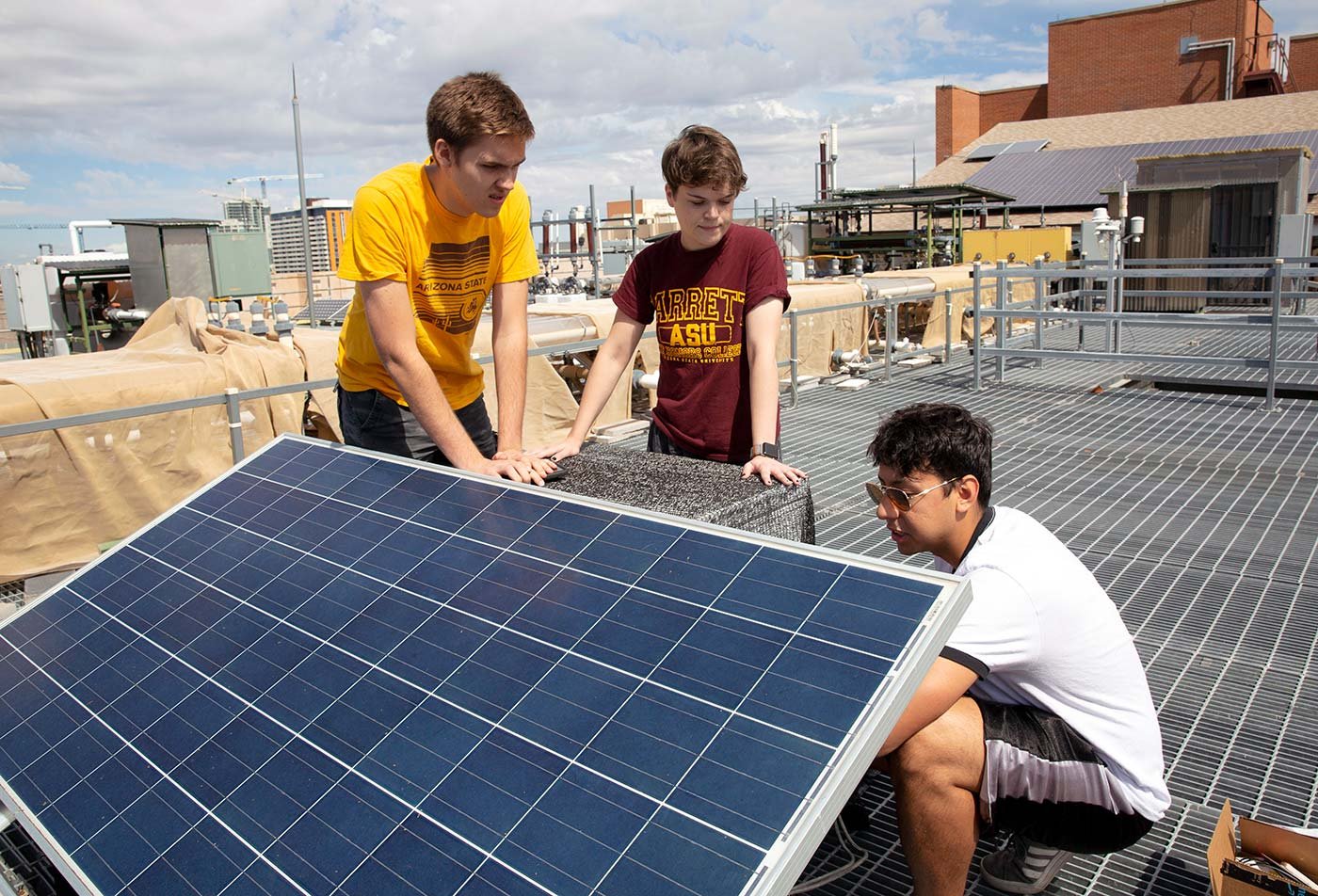
Fossil fuel dependency puts future generations in jeopardy --- not only because these energy sources is depleted, but also because they threaten the survival of life on the planet through global warming effects. The goal of the concentration in clean energy systems within the Bachelor of Science in Engineering program is to educate you in promoting and establishing new and renewable energy sources to reduce carbon footprints. Emphasis on clean energy systems is truly a global phenomenon, and there is a need for collaborative work on a global scale, ranging from developing ideas for new designs to implementing those designs into viable energy production systems. In this program, you prepare to collaborate across disciplines to design and build solutions to practical problems.
You apply fundamental engineering knowledge and design thinking to real projects every semester. In this concentration, you build a broad engineering foundation to which you add the skills and knowledge you need to contribute clean energy systems expertise in transdisciplinary engineering teams; you learn energy conversion processes and gain knowledge and skills in batteries, photovoltaics, fuel cells, wind energy and solar heating. This expertise includes hybrid energy systems and applications.
The program enables you to develop sophisticated technical skills in tandem with the professional skills of communication, teamwork, collaboration, self-motivation and adaptability, and the program's emphasis on open-ended design and project-based learning supports the development of entrepreneurial skills and attitudes.
Accredited by the Engineering Accreditation Commission of ABET, https://www.abet.org, under the General Criteria and the Engineering, General Engineering, Engineering Physics, and Engineering Science Program Criteria.
Why specialize in clean energy systems at ASU?
While most engineering programs reserve capstone design for the final year, this program offers hands-on design projects every semester, building engineering judgment progressively rather than all at once.
Through Ira A. Fulton Schools of Engineering, you gain access to research opportunities, interdisciplinary electives and a faculty network reaching across virtually every engineering domain.
Additional details
Beyond the classroom, you can plug into student groups that turn ideas into impact. The GlobalResolve Club promotes social entrepreneurship through projects that improve lives in underprivileged communities. Mission-driven teams like the Solar Devils design and build a solar-powered electric car, based on the Tempe campus but open to all engineering students, while Desert WAVE explores renewable and sustainable systems alongside its robotics focus.
Courses
Explore a sample list of courses you may take in this program.
| Sample courses |
|---|
| EGR 101 Foundations of Engineering Design Project I |
| EGR 102 Foundations of Engineering Design Project II |
| EGR 201 Use-Inspired Design Project I |
| EGR 202 Use-Inspired Design Project II |
| EGR 216 Engineering Electrical Fundamentals |
| EGR 217 Engineering Mechanics Fundamentals |
Course checksheet and curriculum archive
The curriculum checksheet displays this program's required courses and other requirements you must complete for graduation.
Current ASU students, see how your courses can apply to another major and find out how to change your major (opens in new window).






Already completed some college courses? Build on your success.
If you earned college credit outside ASU, our transfer tools map out your progress towards a degree and help you plan next steps.
See how your credits may apply (opens in new window)Admission requirements
Here are the admission and application details
All students are required to meet general university admission requirements.
First year (opens in new window) | Transfer (opens in new window) | International (opens in new window) | Readmission (opens in new window)
A current ASU student must have a minimum cumulative ASU GPA of 2.00 to change majors to this program.
Students should visit the Change of Major form (opens in new window) for information about how to change a major to this program.
Explore expanded study opportunities
This program allows you to obtain both a bachelor's and a master's degree in as little as five years. As a high-achieving student, accelerated bachelor's plus master's degree programs are designed for you to share undergraduate coursework with graduate coursework to accelerate completion of your master's degree. These programs feature the same high-quality curriculum taught by ASU's world-renowned faculty.
This program is offered as an accelerated bachelor's plus master's degree with:
Approval to pursue the accelerated master's is typically granted during the junior year of your bachelor's degree program. If you are interested, you can learn more about eligibility requirements and how to apply.
When you pursue concurrent degrees (also known as a “double major”), you earn two distinct degrees and receive two diplomas. Working with your academic advisor, you can create your own concurrent degree combination. Some combinations are not possible due to high levels of overlap in curriculum.
With more than 300 Global Education program opportunities available to them, engineering students are able to tailor their experience to their specific interests and skill sets. Whether in a foreign country, in the U.S. or online, students build communication skills, learn to adapt and persevere, and are exposed to research and internships across the world, increasing their professional network.
Students are encouraged to leverage available resources, such as study abroad programs, internships at international industry partners and multinational team participation, to develop new design ideas.


Paying for college
Use our calculator to estimate your full-time or part-time tuition fees for this program prior to any financial aid. Keep in mind that most of our students receive financial aid, which can reduce out-of-pocket costs.
Get an estimate


Build the career and future you want
Our graduates are prepared for a variety of career paths, including:
| Career | Growth | Median Salary | More Information |
|---|---|---|---|
| Fuel Cell Engineer | 11.2% | $104,110 | Learn more |
| Solar Energy Systems Engineer | 3.7% | $122,930 | Learn more |
Example job titles and salaries listed are not necessarily entry level, and students should take into consideration how years of experience and geographical location may affect pay scales. Some jobs also may require advanced degrees, certifications or state-specific licensure.
Data obtained from the Occupational Information Network (O*NET) under sponsorship of the U.S. Department of Labor/Employment and Training Administration (USDOL/ETA).
More about careers
Careers this clean energy systems concentration prepares you for
Graduates have the knowledge and skills necessary to be successful in the area of clean energy systems and related applications, including:
- emerging technology areas that use clean energy resources such as batteries, fuel cells, and wind and solar energy
- the fields of electric and hybrid vehicles, autonomous vehicle systems, and power generation from alternate energy sources
- other related industries as the transition from traditional to other energy sources takes place in all sectors of engineering
Contact information
Use the contact information below to get in touch if you're a current student or have general questions.
Prospective students should fill out the Request for Information form.
Engineering Programs
|
SUTON 240
polyadvising@asu.edu
480-727-1874
Frequently asked questions about degree programs
Accelerated programs allow students the opportunity to expedite the completion of their degree.
Accelerated master's
These programs allow students to accelerate their studies to earn a bachelor's plus a master's degree in as few as five years (for some programs).
Each program has requirements students must meet to be eligible for consideration. Students typically receive approval to pursue the accelerated master's during the junior year of their bachelor's degree program. Interested students can learn about eligibility requirements and how to apply.
Concurrent degrees allow students to pursue their own personal or professional interests, earn two distinct degrees and receive two diplomas. To add a concurrent degree to your existing degree, work with your academic advisor.
Joint programs, or jointly conferred degrees, are offered by more than one college and provide opportunities for students to take advantage of the academic strengths of two academic units. Upon graduation, students are awarded one degree and one diploma conferred by two colleges.
ASU adds new programs to Degree Search frequently. Come back often and look for the "New Programs" option.
ASU Online offers programs in an entirely online format with multiple enrollment sessions throughout the year. See https://asuonline.asu.edu/ for more information.
