

Art (Ceramics), BFA
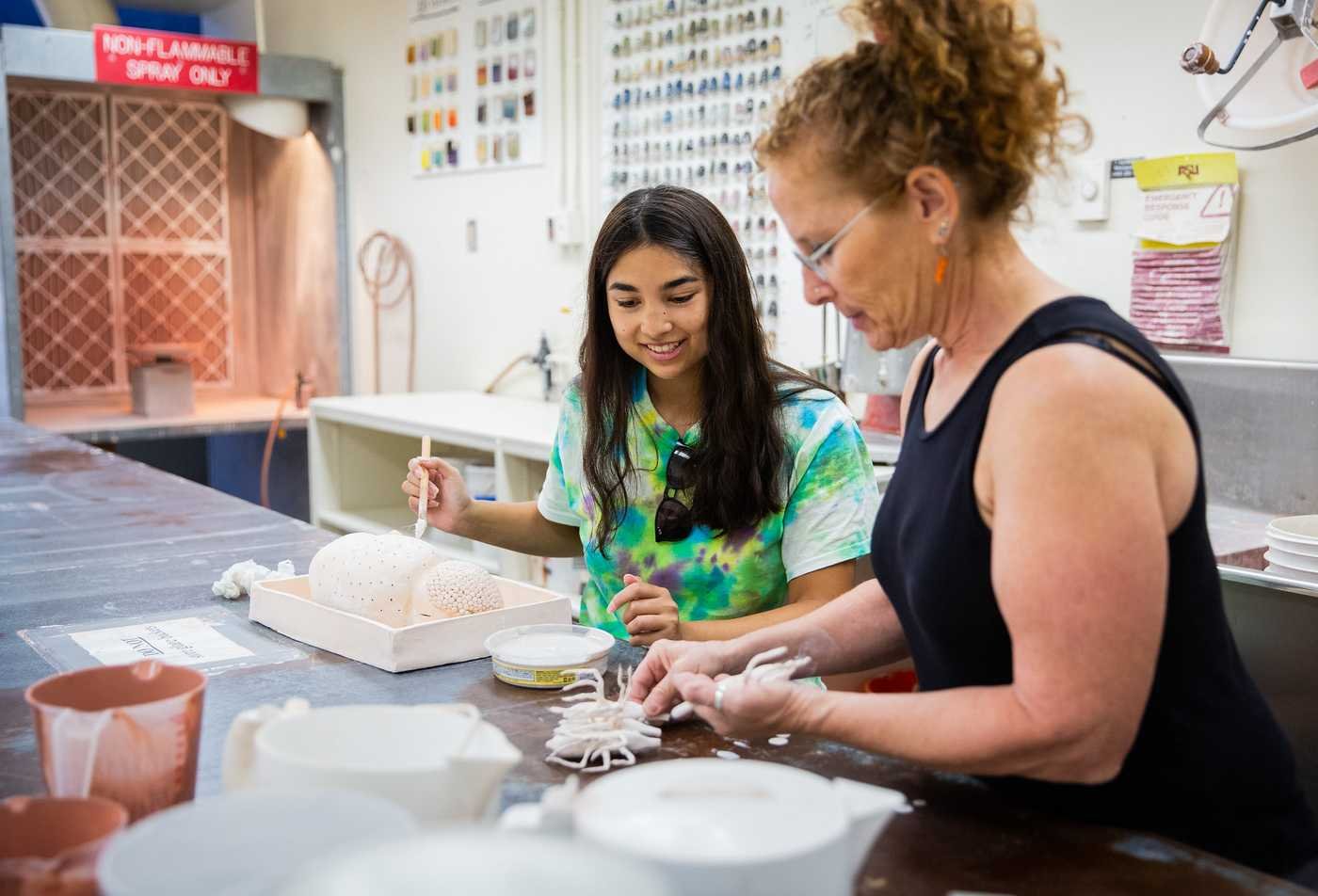
Gain hands-on experience in ceramics and explore a variety of materials, techniques and subjects. You'll have exceptional opportunities to study art, enabling you to reach the highest levels of research, learning, production and critical thinking.
Quick facts

Locations


Courses

Any math course that meets the MATH designation.
Additional facts
STEM-OPT extension eligible: No
International students (F1), this program is not eligible for the STEM-OPT extension.
Accreditation
Accredited by the Higher Learning Commission.


Degree description
In the Bachelor of Fine Arts program in art with a concentration in ceramics, you acquire a foundation of skills and knowledge that draws connections between historical methods and emerging art practices. You develop the ability to think critically and communicate through your art as you explore a wide variety of approaches to advance ideas and discourses, including hand building, throwing, moldmaking and installation.
The curriculum emphasizes conceptual and material knowledge, interdisciplinary research, and professional mentorship. Distinguished faculty provide expertise across an array of distinct areas within the field of contemporary art, including functional ceramics, sculpture, installation, design and performance. Capstone research courses guide you through the process of developing a portfolio of completed works, and you gain practical experience presenting art in many professional contexts.
In addition to classroom learning, the program is also enriched by arts organizations and cultural institutions, which provide you with the opportunity to build your professional network through fellowships, internships and residencies. The program is further augmented by public events supported by the School of Art galleries, the ASU Art Museum, the Ceramics Research Center and Archive, and Pyracantha Press.
You should visit the art areas of study page to learn more about the program. To engage the school's creative community, you can subscribe to the School of Art newsletters and follow the school on social media.
Courses
Explore a sample list of courses you may take in this program.
| Sample courses |
|---|
| ARS 201 Art of Asia |
| ARA 396 Professional Practices for Design and the Arts |
| ARA 240 Encounters with Contemporary Art |
| ART 111 Foundation Drawing |
| ART 113 Pictorial Investigations and Color Theory |
| ART 115 3D Design |

Course checksheet and curriculum archive
The curriculum checksheet displays this program's required courses and other requirements you must complete for graduation.
Current ASU students, see how your courses can apply to another major and find out how to change your major (opens in new window).


Already completed some college courses? Build on your success.
If you earned college credit outside ASU, our transfer tools map out your progress towards a degree and help you plan next steps.
See how your credits may apply (opens in new window)What you'll learn
The following learning outcomes highlight some of the knowledge and skills you'll develop to support your future success.
- Create works of art demonstrating technical, aesthetic, and conceptual skills.
- Develop a comprehensive toolkit for self-promotion that will position them for success in the field of art and design.
- Create a cohesive body of artwork organized and shared in a professional digital portfolio.
 Create works of art demonstrating technical, aesthetic, and conceptual skills.
Admission requirements
Here are the admission and application details
All students are required to meet general university admission requirements.
First year (opens in new window) | Transfer (opens in new window) | International (opens in new window) | Readmission (opens in new window)
Students are admitted directly to the ceramics concentration upon admittance to the BFA program in art.
Transfer admission requirements:
Transfer students who have completed the foundational core and pre-art requirements are admitted directly to the ceramics concentration upon admittance to the BFA program in art. To complete an undergraduate degree in four years, it is recommended that community college transfer students who are completing a two-year degree and have completed the foundational core and pre-art requirements apply and submit a declaration form in the semester in which they are completing their community college degree or the semester before they plan to enter Arizona State University. Direct transfer of courses from other accredited institutions to the Herberger Institute for Design and the Arts is subject to the existence of parallel and equal courses in the college's curriculum and to departmental or school evaluation of studio courses with respect to performance standards. Every candidate for the bachelor's degree must earn a minimum of 30 credit hours in resident credit at ASU. Transfer students enrolled in the college must complete a minimum of 15 credit hours of resident credit in the major as approved by the faculty.
A current ASU student has no additional requirements for changing majors.
Students should visit the Change of Major form (opens in new window) for information about how to change a major to this program.
Explore expanded study opportunities
When you pursue concurrent degrees (also known as a “double major”), you earn two distinct degrees and receive two diplomas. Working with your academic advisor, you can create your own concurrent degree combination. Some combinations are not possible due to high levels of overlap in curriculum.
Global Education programs provide an opportunity for students to explore their creative side through an intercultural lens, deepen their understanding of the world and gain valuable career-building experiences. Study abroad can prove to be a vital accompaniment to any art concentration, allowing for broad historical and archaeological explorations. Students develop insight into the cultures and minds of some of the world's most notable artists when they experience the places that gave rise to specific artistic styles. With more than 300 options available, Global Education programs give students a breadth of knowledge in arts and culture distinctly different from their own. Study abroad encourages students to broaden their intercultural sensitivity, communication skills and leadership ability, and develop their personal and professional confidence. Students who participate in global education programs learn to adapt and persevere, growing along the way.


Paying for college
Use our calculator to estimate your full-time or part-time tuition fees for this program prior to any financial aid. Keep in mind that most of our students recieve financial aid, which can reduce out-of-pocket costs.
Get an estimate


Build the career and future you want
Our graduates are prepared for a variety of career paths, including:
| Career | Growth | Median Salary | More Information |
|---|---|---|---|
| Art Professor | 2.2% | $78,620 | Learn more |
| Craft Artist | 2.0% | $46,080 | Learn more |
| Fine Artist | -2.9% | $55,490 | Learn more |
| Foundry Mold and Coremaker | -23.0% | $48,110 | Learn more |
| Graphic Designer | -1.7% | $62,960 | Learn more |
| High School Teacher | -0.2% | $72,040 | Learn more |
| Industrial Designer | 2.4% | $83,910 | Learn more |
| Metal Worker | -7.1% | $45,950 | Learn more |
| Performance Artist | 2.0% | $71,240 | Learn more |
| Talent Agent | 9.7% | $82,890 | Learn more |
Example job titles and salaries listed are not necessarily entry level, and students should take into consideration how years of experience and geographical location may affect pay scales. Some jobs also may require advanced degrees, certifications or state-specific licensure.
Data obtained from the Occupational Information Network (O*NET) under sponsorship of the U.S. Department of Labor/Employment and Training Administration (USDOL/ETA).
More about careers
An art degree offers graduates a pathway to creative careers as artists, scholars and educators in the public and private spheres. Artists find employment opportunities as practitioners in the field through commercial galleries, public art commissions, private collectors and cultural institutions. Positions of employment include museum or gallery professional, art dealer, art director, private art instructor, studio artist and community-based artist. Venues might include health care settings, nonprofit agencies, and local and national public arts organizations. Other options for graduates include working at arts agencies and for public art programs, gaining admission to prestigious graduate programs, and setting up their own art businesses. The skills acquired to produce art also have a wide variety of non-art applications.
Contact information
Use the contact information below to get in touch if you're a current student or have general questions.
Prospective students should fill out the Request for Information form.
School of Art
|
ART 102
herbergeradvising@asu.edu
480-965-8521
Frequently asked questions about degree programs
Accelerated programs allow students the opportunity to expedite the completion of their degree.
Accelerated master's
These programs allow students to accelerate their studies to earn a bachelor's plus a master's degree in as few as five years (for some programs).
Each program has requirements students must meet to be eligible for consideration. Students typically receive approval to pursue the accelerated master's during the junior year of their bachelor's degree program. Interested students can learn about eligibility requirements and how to apply.
Concurrent degrees allow students to pursue their own personal or professional interests, earn two distinct degrees and receive two diplomas. To add a concurrent degree to your existing degree, work with your academic advisor.
Joint programs, or jointly conferred degrees, are offered by more than one college and provide opportunities for students to take advantage of the academic strengths of two academic units. Upon graduation, students are awarded one degree and one diploma conferred by two colleges.
ASU adds new programs to Degree Search frequently. Come back often and look for the "New Programs" option.
ASU Online offers programs in an entirely online format with multiple enrollment sessions throughout the year. See https://asuonline.asu.edu/ for more information.
