

Dance (Dance Education), BFA
Are you passionate about dance and teaching? Grow as a performer and educator as you train with expert faculty, build real-world skills, and join a creative community that prepares you for a career in dance education.
Quick facts

Locations


Courses

or any math course that meets the MATH designation.
Additional facts
STEM-OPT extension eligible: No
International students (F1), this program is not eligible for the STEM-OPT extension.
Accreditation and professional licensure
Accredited by the Higher Learning Commission.


Degree description
In the Bachelor of Fine Arts program in dance with a concentration in dance education, you prepare to become a certified K-12 dance teacher in Arizona (and many other states, through reciprocity agreements).
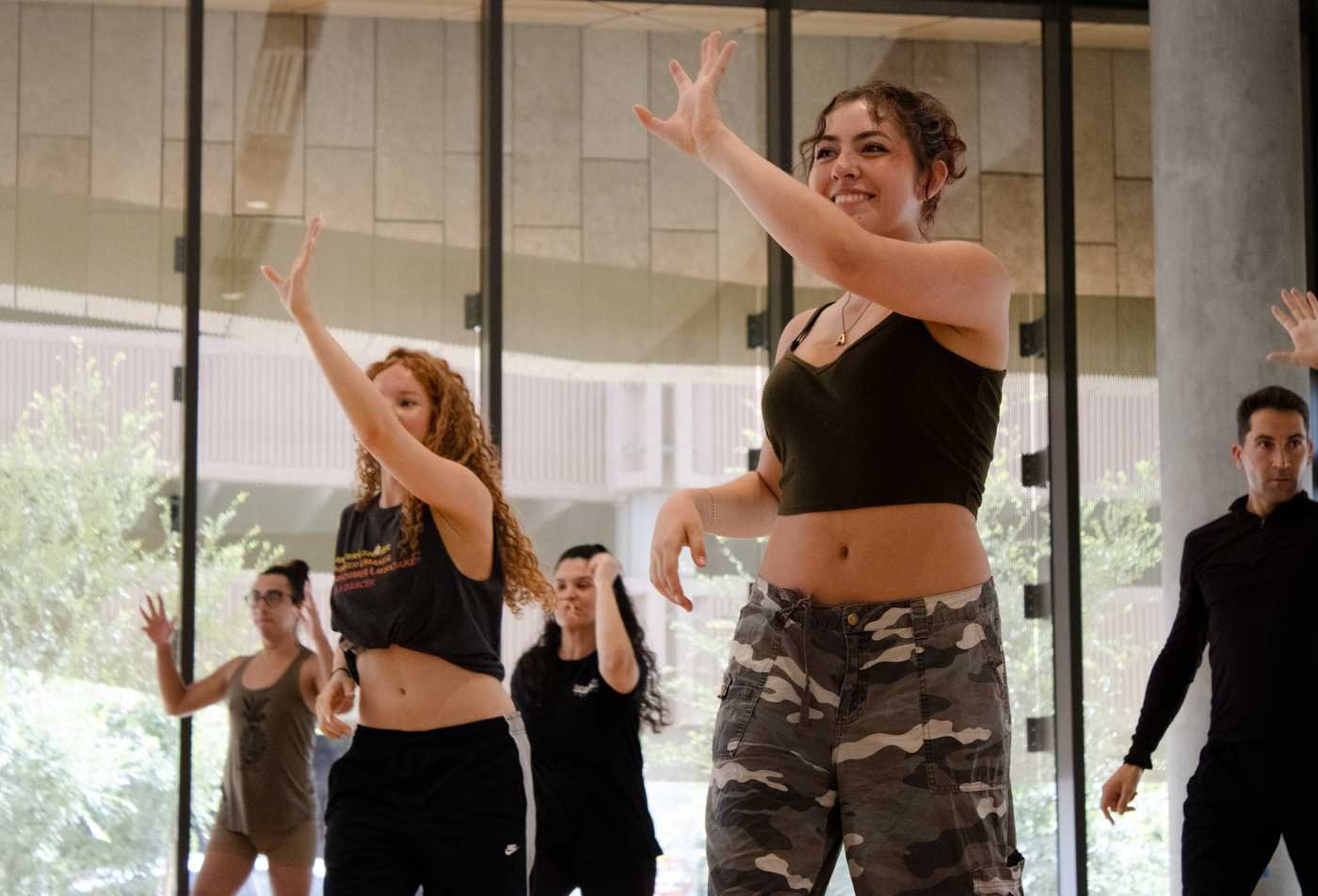
At the School of Music, Dance and Theatre, you train in a supportive and inclusive environment that helps you grow as an artist and educator. You study dance technique (Afro-Latin, contemporary ballet, hip hop, modern, somatics), dance history, music, movement science, digital media and stage production.
The curriculum combines creativity, research and hands-on experience --- including student teaching internships --- so you complete the program ready to teach, choreograph and inspire the next generation of dancers.
Courses
Explore a sample list of courses you may take in this program.
| Sample courses |
|---|
| DCE 132 First-Year Dance Techniques |
| DCE 136 Introduction to Somatic Movement |
| DCE 160 Creative Practices I |
| DCE 161 Creative Practices II |
| DCE 201 Dance, Culture, and Global Contexts |
| DCE 205 How Dance Matters: A Sociocultural Framing |

Course checksheet and curriculum archive
The curriculum checksheet displays this program's required courses and other requirements you must complete for graduation.
Current ASU students, see how your courses can apply to another major and find out how to change your major (opens in new window).


Already completed some college courses? Build on your success.
If you earned college credit outside ASU, our transfer tools map out your progress towards a degree and help you plan next steps.
See how your credits may apply (opens in new window)What you'll learn
The following learning outcomes highlight some of the knowledge and skills you'll develop to support your future success.
- Apply creative perspectives and skills in their art-making that reflect broad understandings of current dance and digital media practices.
- Develop pedagogical approaches and curricular content for PreK-12 and community dance education settings.
- Apply knowledge of past and current dance practices, traditions and trends in one or more global or historical dance forms.
 Apply creative perspectives and skills in their art-making that reflect broad understandings of current dance and digital media practices.
Admission requirements
Here are the admission and application details
All students are required to meet general university admission requirements.
First year (opens in new window) | Transfer (opens in new window) | International (opens in new window) | Readmission (opens in new window)
Students are strongly encouraged to attend the Dance Summit held in the fall semester or the Be a Dance Major days held in the spring semester to learn about the dance program at ASU. Dance scholarships are available to all applicants. Details on how to register for a dance event and dance scholarships are found on the School of Music, Dance and Theatre website.
Transfer admission requirements:
Direct transfer of courses from other accredited institutions to the Herberger Institute for Design and the Arts is subject to the existence of parallel and equal courses in the college's curriculum and to departmental or school evaluation of studio courses with respect to performance standards. Every candidate for the bachelor's degree must earn a minimum of 30 hours in resident credit at ASU. Transfer students enrolled in the institute must complete a minimum of 15 hours of resident credit in the major as approved by the faculty. Students should review School of Music, Dance and Theatre website for more details.
An ASU student who would like to change their major to one offered by the Herberger Institute for Design and the Arts must have a minimum cumulative GPA of 2.50.
Students should visit the Change of Major form (opens in new window) for information about how to change a major to this program.
Explore expanded study opportunities
When you pursue concurrent degrees (also known as a “double major”), you earn two distinct degrees and receive two diplomas. Working with your academic advisor, you can create your own concurrent degree combination. Some combinations are not possible due to high levels of overlap in curriculum.
Dance transcends language, so students can explore their art in various countries, no matter the language. When studying abroad, students expand their view of dance through an international lens while exploring various dance forms at their origins, gaining knowledge that helps them become educators of the art.


Paying for college
Use our calculator to estimate your full-time or part-time tuition fees for this program prior to any financial aid. Keep in mind that most of our students recieve financial aid, which can reduce out-of-pocket costs.
Get an estimate


Build the career and future you want
Our graduates are prepared for a variety of career paths, including:
| Career | Growth | Median Salary | More Information |
|---|---|---|---|
| Choreographer | 3.1% | $55,310 | Learn more |
| Dancer | 2.2% | Not available | Learn more |
| Education Professor | 2.5% | $75,350 | Learn more |
| Fitness Instructor | 7.3% | $47,160 | Learn more |
| Health and Physical Education Professor (HPE Professor) | 2.2% | $77,270 | Learn more |
| High School Teacher | -0.2% | $72,040 | Learn more |
| Middle School Teacher | -0.4% | $64,370 | Learn more |
| Preschool Director | -3.1% | $59,300 | Learn more |
| School Principal | -0.3% | $105,870 | Learn more |
Example job titles and salaries listed are not necessarily entry level, and students should take into consideration how years of experience and geographical location may affect pay scales. Some jobs also may require advanced degrees, certifications or state-specific licensure.
Data obtained from the Occupational Information Network (O*NET) under sponsorship of the U.S. Department of Labor/Employment and Training Administration (USDOL/ETA).
More about careers
The concentration in dance education lays the foundation for a career in teaching in public and private settings, as a dance educator in K-12 settings, as a teacher in private studio or community environments, or as an independent dance artist and performer. Graduates have an Arizona teaching certification and a degree in dance, and they can expect to find employment in one of many thriving middle school and high school dance programs throughout the state, community settings or dance studios.
Contact information
Use the contact information below to get in touch if you're a current student or have general questions.
Prospective students should fill out the Request for Information form.
School of Music, Dance and Theatre
|
MUSIC E167
MDTAdmissions@asu.edu
480-965-5069
Frequently asked questions about degree programs
Accelerated programs allow students the opportunity to expedite the completion of their degree.
Accelerated master's
These programs allow students to accelerate their studies to earn a bachelor's plus a master's degree in as few as five years (for some programs).
Each program has requirements students must meet to be eligible for consideration. Students typically receive approval to pursue the accelerated master's during the junior year of their bachelor's degree program. Interested students can learn about eligibility requirements and how to apply.
Concurrent degrees allow students to pursue their own personal or professional interests, earn two distinct degrees and receive two diplomas. To add a concurrent degree to your existing degree, work with your academic advisor.
Joint programs, or jointly conferred degrees, are offered by more than one college and provide opportunities for students to take advantage of the academic strengths of two academic units. Upon graduation, students are awarded one degree and one diploma conferred by two colleges.
ASU adds new programs to Degree Search frequently. Come back often and look for the "New Programs" option.
ASU Online offers programs in an entirely online format with multiple enrollment sessions throughout the year. See https://asuonline.asu.edu/ for more information.
