

Performance (Collaborative Piano), BMUS
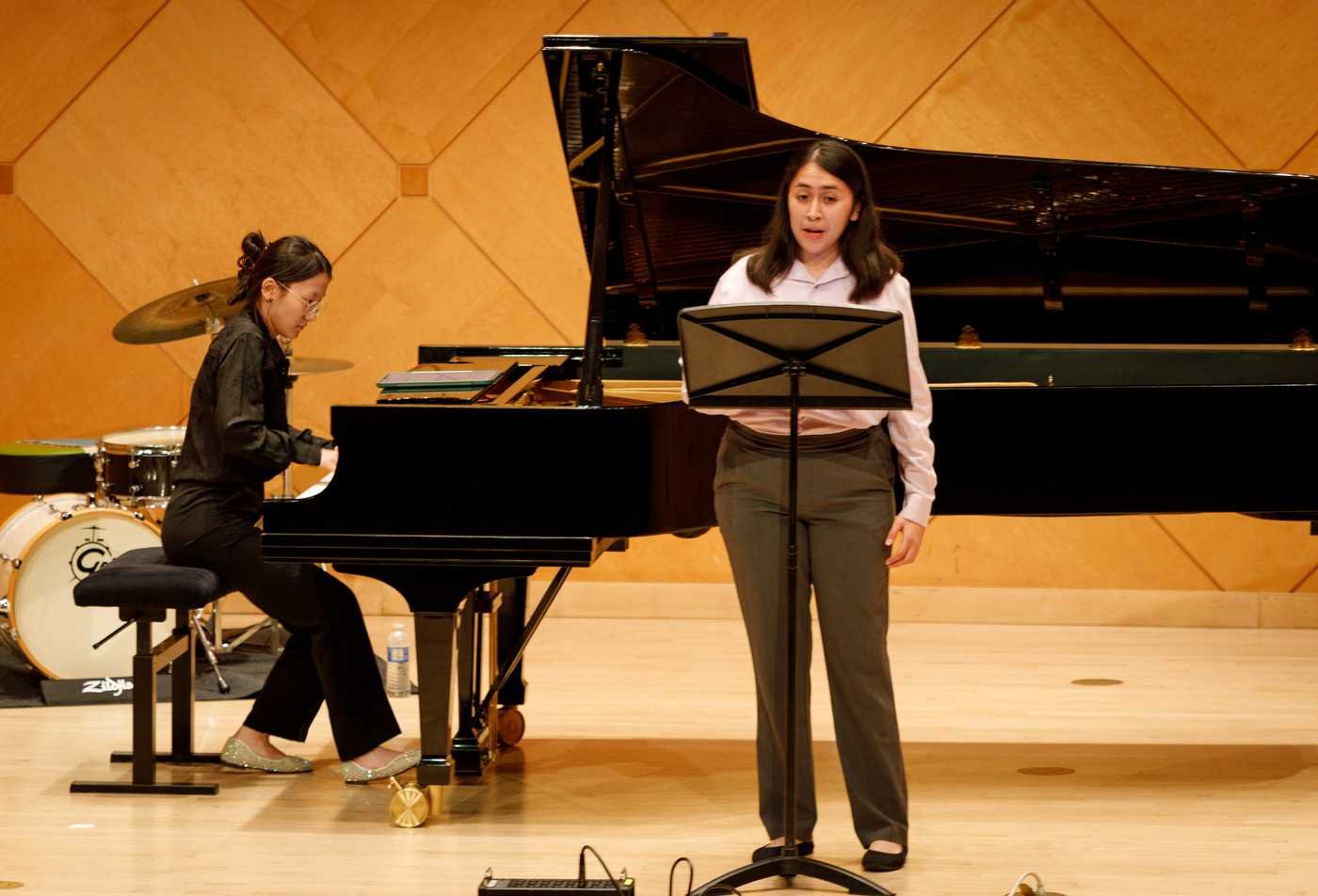
Perform alongside vocalists, instrumentalists and ensembles as you build your craft. This performance pathway showcases your creativity through concerts across the valley, preparing you to thrive as a collaborative pianist.
Quick facts

Locations


Courses

Any math course that meets the MATH designation.
Additional facts
STEM-OPT extension eligible: No
International students (F1), this program is not eligible for the STEM-OPT extension.
Accreditation
Accredited by the Higher Learning Commission.


Degree description
Performance (Collaborative Piano) degree description
The Bachelor of Music program in performance with a concentration in collaborative piano offers you private instruction in solo and collaborative piano; coaching with faculty members on chamber music, song, operatic and musical theatre repertoire; and opportunities with large ensemble and choral programs. This diverse training leads directly to vibrant collaborative performance experiences in all areas, including collaboration with colleagues in dance and theatre.
As a collaborative piano student, you regularly perform with your vocal and instrumental colleagues in concerts at ASU and throughout the valley, including at Scottsdale Center for the Performing Arts, the Kerr Cultural Center, Tempe Center for the Arts and the renowned Musical Instrument Museum.
The program combines two years of focused study of solo piano repertoire and two years of collaborative piano training, and focuses on the core repertoire of song, piano chamber music, opera and musical theater. Collaboration within the School of Music, Dance and Theatre involves all performance areas, including classes and opportunities with the music theatre and opera programs, concerts with large ensembles and choirs, duo recitals with instrumental and voice colleagues, and performances of chamber music literature as part of the Visiting Quartet Residency program.
Why specialize in collaborative piano at ASU?
You gain experience in and out of the classroom, learning from guest artists in residencies, workshops and masterclasses; receiving one-on-one support from diverse faculty who are leaders in their field; and performing at solo and ensemble performance opportunities.
Courses
Explore a sample list of courses you may take in this program.
| Sample courses |
|---|
| MHL 140 Sounds and Cultures |
| MTC 125 Music Theory I |
| MTC 221 Music Theory II |
| MTC 222 Music Theory III |
| MUP 127 Studio Instruction |
| MUP 209 Beginning Choral Conducting |

Course checksheet and curriculum archive
The curriculum checksheet displays this program's required courses and other requirements you must complete for graduation.
Current ASU students, see how your courses can apply to another major and find out how to change your major (opens in new window).


Already completed some college courses? Build on your success.
If you earned college credit outside ASU, our transfer tools map out your progress towards a degree and help you plan next steps.
See how your credits may apply (opens in new window)What you'll learn
The following learning outcomes highlight some of the knowledge and skills you'll develop to support your future success.
- Develop performance practices in the context of diverse musical settings and genres, demonstrating familiarity with the literature of one's instrument, as well as an overview of vocal and instrumental literature.
- Evaluate piano and related repertoire and pedagogy to develop a unique musical style.
- Produce a research study focusing on musical elements, social uses of music, and interplay among performers, composers, and institutions.
 Develop performance practices in the context of diverse musical settings and genres, demonstrating familiarity with the literature of one's instrument, as well as an overview of vocal and instrumental literature.
Admission requirements
Here are the admission and application details
All students are required to meet general university admission requirements.
First year (opens in new window) | Transfer (opens in new window) | International (opens in new window) | Readmission (opens in new window)
Important: Applicants must submit an ASU application for undergraduate admission in addition to a separate School of Music, Dance and Theatre application. Admission to the School of Music, Dance and Theatre is based on an audition. Auditions take place in November (spring admission) and in January and February (fall admission) of each year. Admission to the music program is highly selective and based on an audition process. Students are admitted as music audition students and must successfully complete the audition before enrolling in music major courses. Upon admission to both ASU and the School of Music, Dance and Theatre, the applicant's major is changed to music. If a student is admitted to ASU but not to the School of Music, Dance and Theatre or misses the audition deadline, the student remains a music audition major and must successfully pass the music audition milestone in the first semester to gain admission into the program. Application deadlines: Students should review the complete music deadline information. Spring admission: The deadline to apply for admission to this program is October 15. Fall admission: The deadline to apply for admission to this program is January 5.
Transfer admission requirements:
Transfer applicants: Transfer of courses from other accredited institutions is subject to the existence of parallel and equal courses in the college's curriculum and to departmental or school evaluation of studio and class piano courses with respect to performance standards. Every candidate for the bachelor's degree must earn a minimum of 30 hours in resident credit at ASU. Transfer students enrolled in the institute must complete a minimum of 15 resident credit hours in the major as approved by the faculty. Application deadlines: Students should review the complete music deadline information. Spring admission: The deadline to apply for admission to this program is October 15. Fall admission: The deadline to apply for admission to this program is January 5.
Students who want to change their major to this one should reference the audition requirements listed in the admission requirements section above.
Students should visit the Change of Major form (opens in new window) for information about how to change a major to this program.
Explore expanded study opportunities
When you pursue concurrent degrees (also known as a “double major”), you earn two distinct degrees and receive two diplomas. Working with your academic advisor, you can create your own concurrent degree combination. Some combinations are not possible due to high levels of overlap in curriculum.
Students who experience music in different countries expand their understanding of musical performance. Many ASU faculty members are involved in summer music festivals throughout the world and often bring their ASU students to experience this global environment of collaboration.
With more than 300 Global Education program opportunities available to them, piano students are able to tailor their experience to their interests and skill sets. Whether in a foreign country, in the U.S. or online, students build communication skills, learn to adapt and persevere, and are exposed to research and internships around the world, increasing their professional network.


Paying for college
Use our calculator to estimate your full-time or part-time tuition fees for this program prior to any financial aid. Keep in mind that most of our students recieve financial aid, which can reduce out-of-pocket costs.
Get an estimate


Build the career and future you want
Our graduates are prepared for a variety of career paths, including:
| Career | Growth | Median Salary | More Information |
|---|---|---|---|
| Art Professor | 2.2% | $78,620 | Learn more |
| Music Producer | 1.2% | $73,710 | Learn more |
| Musician/Singer | 0.3% | Not available | Learn more |
Example job titles and salaries listed are not necessarily entry level, and students should take into consideration how years of experience and geographical location may affect pay scales. Some jobs also may require advanced degrees, certifications or state-specific licensure.
Data obtained from the Occupational Information Network (O*NET) under sponsorship of the U.S. Department of Labor/Employment and Training Administration (USDOL/ETA).
More about careers
Careers this collaborative piano concentration prepares you for
Graduates are prepared to work in various professional or entrepreneurial capacities, including:
- performing as a collaborative pianist with singers and instrumentalists
- performing as a pianist with large instrumental ensembles
- performing as a pianist for music recording and studio work
- rehearsing and performing as a pianist with choral ensembles
- rehearsing and performing as a pianist for musical theatre or opera productions
- teaching in a private studio or community music program
- working as a vocal coach
Graduates also find collaborative work in music-related fields such as:
- marketing
- media production
- music business
- publishing
Many graduates pursue a master's degree or a doctorate in music, or in another professional field.
Contact information
Use the contact information below to get in touch if you're a current student or have general questions.
Prospective students should fill out the Request for Information form.
School of Music, Dance and Theatre
|
MUSIC E167
MDTAdmissions@asu.edu
480-965-5069
Frequently asked questions about degree programs
Accelerated programs allow students the opportunity to expedite the completion of their degree.
Accelerated master's
These programs allow students to accelerate their studies to earn a bachelor's plus a master's degree in as few as five years (for some programs).
Each program has requirements students must meet to be eligible for consideration. Students typically receive approval to pursue the accelerated master's during the junior year of their bachelor's degree program. Interested students can learn about eligibility requirements and how to apply.
Concurrent degrees allow students to pursue their own personal or professional interests, earn two distinct degrees and receive two diplomas. To add a concurrent degree to your existing degree, work with your academic advisor.
Joint programs, or jointly conferred degrees, are offered by more than one college and provide opportunities for students to take advantage of the academic strengths of two academic units. Upon graduation, students are awarded one degree and one diploma conferred by two colleges.
ASU adds new programs to Degree Search frequently. Come back often and look for the "New Programs" option.
ASU Online offers programs in an entirely online format with multiple enrollment sessions throughout the year. See https://asuonline.asu.edu/ for more information.
