

Film and Media Production (Screenwriting), BFA
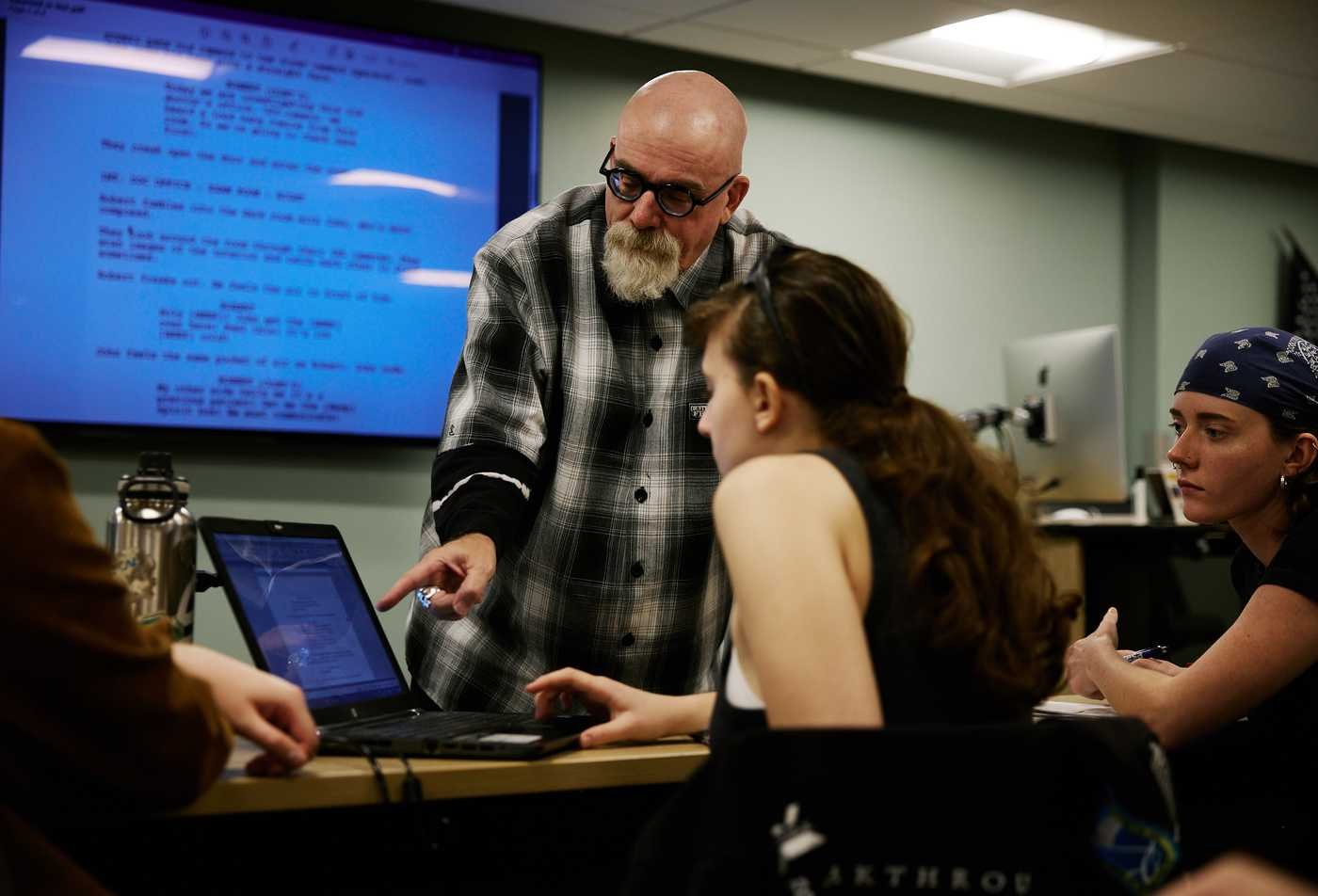
Build a professional portfolio and gain hands-on production experience as you learn to craft impactful stories in film, television and emerging media. This screenwriting concentration sets your story in motion.
Quick facts


Courses

Additional facts
STEM-OPT extension eligible: No
International students (F1), this program is not eligible for the STEM-OPT extension.
Accreditation
Accredited by the Higher Learning Commission.


Degree description
BFA in Film and Media Production (Screenwriting) degree description
A Bachelor of Fine Arts from The Sidney Poitier New American Film School empowers you with the critical thinking skills to navigate new, complex and changing environments in the film industry. The school's programs nurture you to be a part of the next generation of creatives, emphasizing the interconnectivity of filmmaking, the evolving landscape of the screen, and the journey of a story from idea to intended audience. With a foundation in ethical and collaborative practices and project-based learning using state-of-the-art technology, the school offers the most inclusive, affordable and innovative film programs in the country.
The BFA program in film and media production provides a deep dive into film production. It takes you beyond theory and teaches you how to communicate a vision and manage resources to take a story from page to screen.
Screenwriting concentration
This concentration program emphasizes the art of storytelling as the backbone of film and media, training you to craft narratives that connect across cultures and convey the complexity of the human experience. Reflecting the school's commitment to impactful storytelling, this pathway prepares you to create scripts that drive meaningful conversations and bring fresh perspectives to the screen.
Why specialize in screenwriting at ASU?
In Arizona, you learn and create at the ASU MIX Center, a 118,000-square-foot facility for film, media arts, design and emerging technology in downtown Mesa. Its script-to-screen capabilities, soundstages, a color-grading room, sound-mixing studios, editing bays and screening theaters let you master every stage of filmmaking. The concentration also brings filmmakers and media professionals to campus through speaker series and guest artist events, giving you direct access to industry insights and networking opportunities. You can meet and learn from Oscar and Emmy-award-winning luminaries to gain valuable insight into honing artistic vision, staying at the cutting edge of the latest technical innovations, and building a lasting career in the entertainment industry. Notable recent guests include Ben Burtt (Oscar-winning sound designer of ¿Star Wars¿), Brian Connor (Oscar-winning VFX supervisor of ¿Dune: Part One¿), Stephen Rivkin (Oscar-nominated editor of ¿Avatar¿), and Caleb Deschanel (six-time Oscar-nominated cinematographer of ¿The Right Stuff¿).
California students work at Los Angeles Center Studios, a 20-acre film production campus in the City West neighborhood, close to the ASU California Centers. This working studio lot, the closest to downtown LA and used in more than 4,000 productions, including ¿Mad Men,¿ ¿Dark Knight Rises,¿ ¿CSI¿ and ¿Top Gun: Maverick,¿ opens access to equipment and soundstages.
You create unique work in collaboration with your peers to master digital technologies and tell stories that reflect your individual vision and voice.
Additional details
Through the Semester in LA program, Arizona-based students can spend a semester in Los Angeles, completing internships that build industry experience and professional connections.
ASU is home to a range of film-related student clubs that Poitier Film School students may find worth exploring.
Courses
Explore a sample list of courses you may take in this program.
| Sample courses |
|---|
| FMP 180 Principles of Production Technology |
| FMP 205 Introduction to Post-Production |
| FMP 210 Principles of Creative Producing |
| FMP 245 Concepts of Cinematography |
| FMP 261 Principles of Screenwriting |
| FMP 280 Introduction to Film and Media Production |

Course checksheet and curriculum archive
The curriculum checksheet displays this program's required courses and other requirements you must complete for graduation.
Current ASU students, see how your courses can apply to another major and find out how to change your major (opens in new window).


Already completed some college courses? Build on your success.
If you earned college credit outside ASU, our transfer tools map out your progress towards a degree and help you plan next steps.
See how your credits may apply (opens in new window)What you'll learn
The following learning outcomes highlight some of the knowledge and skills you'll develop to support your future success.
- Analyze a film including the script, its ability to visually tell a story and for its aesthetics supporting their analysis with diverse sources.
- Produce a media-based project following all of the production stages required for successful completion.
- Analyze short, TV series and feature-length film scripts in different genres to produce a script.
 Analyze a film including the script, its ability to visually tell a story and for its aesthetics supporting their analysis with diverse sources.
Admission requirements
Here are the admission and application details
All students are required to meet general university admission requirements.
First year (opens in new window) | Transfer (opens in new window) | International (opens in new window) | Readmission (opens in new window)
An ASU student who would like to change their major to this program and would be new to this major must have a minimum cumulative GPA of 2.25 and understand that their GPA must be brought up to a 2.50 or higher within one semester to remain in good standing. An ASU student who is returning to this major (having studied this major in a prior semester) must have a minimum cumulative GPA of 2.50.
Students should visit the Change of Major form (opens in new window) for information about how to change a major to this program.
Explore expanded study opportunities
When you pursue concurrent degrees (also known as a “double major”), you earn two distinct degrees and receive two diplomas. Working with your academic advisor, you can create your own concurrent degree combination. Some combinations are not possible due to high levels of overlap in curriculum.
The Sidney Poitier New American Film School's Semester in Los Angeles program is an opportunity for upper-division students to live and study in Los Angeles for one semester. The program includes an internship with a film industry company as well as networking events, screenings and site visits to Panavision, Universal Studios, the Academy Museum and more. This is a chance for students to take exclusive in-person courses at the ASU California Center locations while staying on their path to graduation.
For those who wish to go further afield, study abroad provides students a once-in-a-lifetime opportunity to explore the globe while developing distinct skills that can help them stand out in the competitive field of film. With more than 300 Global Education programs available to them, students have an opportunity to explore their creative side through an intercultural lens and acquire a breadth of knowledge in arts and culture uniquely different from their own. Not only do the programs encourage students to build communication skills, but they also challenge them, as artists, to think differently. Besides acquiring intercultural, communication and leadership skills, students have the chance to learn languages and expand their international network.
Whether in a foreign country, in the U.S. or online, Global Education programs challenge students to adapt and persevere, providing them with a chance to look inside themselves in a way they haven't done before, growing their self-confidence along the way.


Paying for college
Use our calculator to estimate your full-time or part-time tuition fees for this program prior to any financial aid. Keep in mind that most of our students recieve financial aid, which can reduce out-of-pocket costs.
Get an estimate


Build the career and future you want
Our graduates are prepared for a variety of career paths, including:
| Career | Growth | Median Salary | More Information |
|---|---|---|---|
| Animator | -0.3% | $102,030 | Learn more |
| Audio-Visual Technician | 3.9% | $58,100 | Learn more |
| Camera Operator | 1.3% | $74,990 | Learn more |
| Executive Producer | 4.0% | $90,360 | Learn more |
| Film Editor | 3.7% | $75,420 | Learn more |
| Freelance Writer | -0.3% | $76,910 | Learn more |
| Production Assistant | 3.9% | $73,620 | Learn more |
| Public Relations Specialist | 1.8% | $74,750 | Learn more |
| Sound Recording Engineer | -3.1% | $73,130 | Learn more |
| Talent Agent | 9.7% | $82,890 | Learn more |
Example job titles and salaries listed are not necessarily entry level, and students should take into consideration how years of experience and geographical location may affect pay scales. Some jobs also may require advanced degrees, certifications or state-specific licensure.
Data obtained from the Occupational Information Network (O*NET) under sponsorship of the U.S. Department of Labor/Employment and Training Administration (USDOL/ETA).
More about careers
Careers this screenwriting concentration prepares you for
Graduates are equipped with the technical know-how and critical thinking skills to thrive in a continually changing media industry and to pioneer new media careers that require advanced production skills and a strong creative voice.
Graduates who earn this degree are prepared to pursue a wide array of skilled professions, including:
- agent or manager
- development executive
- showrunner
- TV, feature or documentary writer
Contact information
Use the contact information below to get in touch if you're a current student or have general questions.
Prospective students should fill out the Request for Information form.
The Sidney Poitier New American Film School
|
GHALL 232
filmadmissions@asu.edu
480-727-7132
Frequently asked questions about degree programs
Accelerated programs allow students the opportunity to expedite the completion of their degree.
Accelerated master's
These programs allow students to accelerate their studies to earn a bachelor's plus a master's degree in as few as five years (for some programs).
Each program has requirements students must meet to be eligible for consideration. Students typically receive approval to pursue the accelerated master's during the junior year of their bachelor's degree program. Interested students can learn about eligibility requirements and how to apply.
Concurrent degrees allow students to pursue their own personal or professional interests, earn two distinct degrees and receive two diplomas. To add a concurrent degree to your existing degree, work with your academic advisor.
Joint programs, or jointly conferred degrees, are offered by more than one college and provide opportunities for students to take advantage of the academic strengths of two academic units. Upon graduation, students are awarded one degree and one diploma conferred by two colleges.
ASU adds new programs to Degree Search frequently. Come back often and look for the "New Programs" option.
ASU Online offers programs in an entirely online format with multiple enrollment sessions throughout the year. See https://asuonline.asu.edu/ for more information.
