

History (Secondary Education), BA
Do you love history? Build critical thinking, writing and oral presentation skills for careers inside or outside the classroom. You'll gain a solid foundation for whatever your postgraduate dreams entail.
Quick facts

Locations


Courses

Additional facts
STEM-OPT extension eligible: No
International students (F1), this program is not eligible for the STEM-OPT extension.
Accreditation and professional licensure
Accredited by the Higher Learning Commission.


History (Secondary Education) degree description
If you are considering a career in education, the secondary education concentration within the Bachelor of Arts program in history offers a flexible degree program for you. The concentration program fully prepares you for teaching and certification. You also receive all the disciplinary knowledge of a traditional history degree to prepare for a variety of noneducation careers.
History is a discipline that constantly adopts novel techniques of analysis and new ways of gathering and presenting information. As a student of history, you learn to use and create digital media, work on public history projects, conduct oral history interviews, perform qualitative analysis and present your findings in compelling ways to all kinds of audiences.
In addition to reviewing the guidelines in the Concurrent Program Options section below, if you're interested in pursuing concurrent or second baccalaureate degrees in The College of Liberal Arts and Sciences, you can visit The College's website for more information and requirements.
Why specialize in history (secondary education) at ASU?
In this concentration, you complete classroom internships and student teaching with a mentor teacher, and you also assess evidence from historical sources to draw informed conclusions.
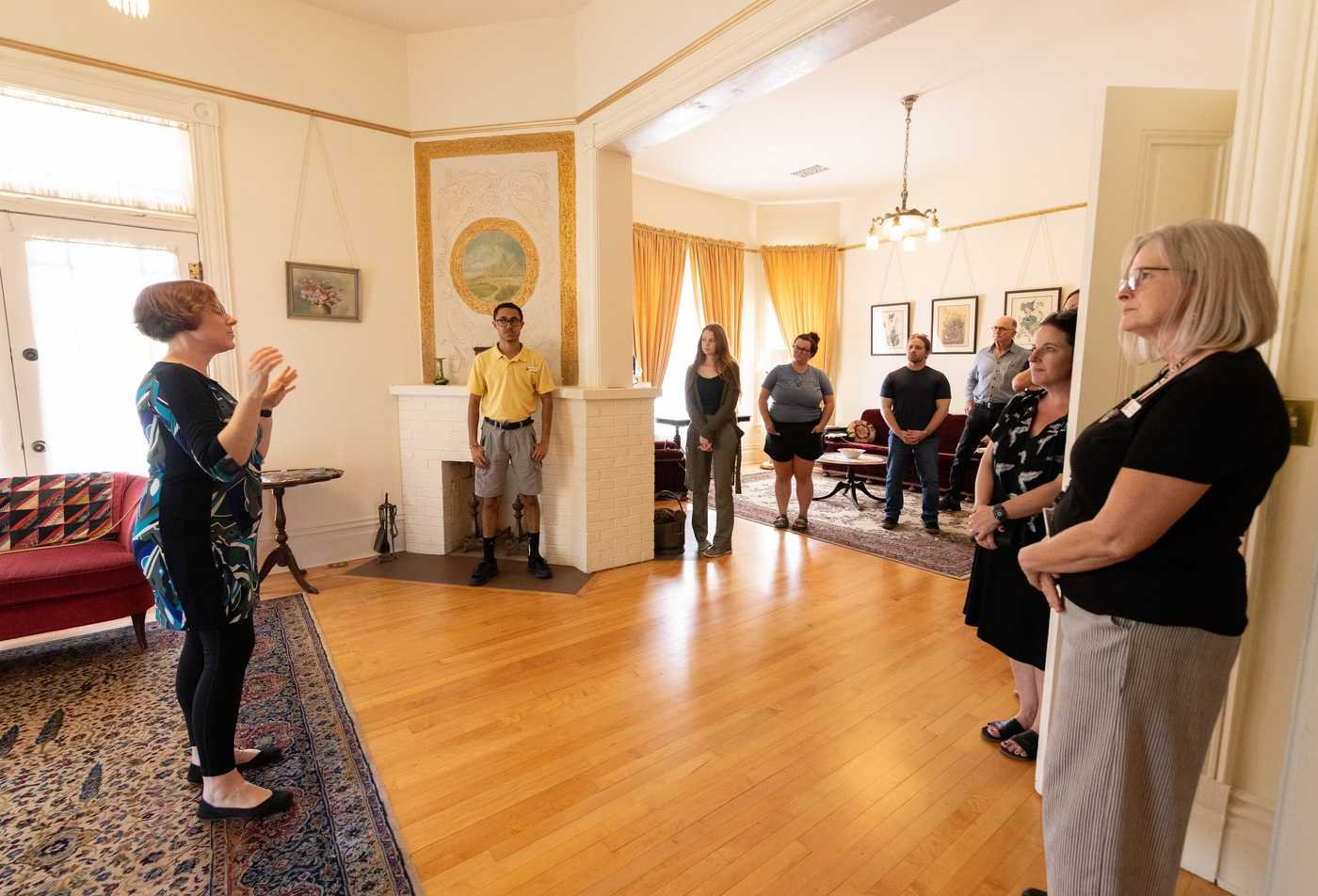
Through undergraduate research experience opportunities, you can partner with local organizations like the Arizona Heritage Center, gaining professional experience on educational projects for schools across the state while earning credit toward your degree.
Courses
Explore a sample list of courses you may take in this program.
| Sample courses |
|---|
| HST 130 The Historian's Craft |
| HST 495 Methods of Historical Inquiry |
| HST 100 Global History to 1500 |
| HST 101 Global History Since 1500 |
| HST 109 United States to 1865 |
| HST 110 United States Since 1865 |
Course checksheet and curriculum archive
The curriculum checksheet displays this program's required courses and other requirements you must complete for graduation.
Current ASU students, see how your courses can apply to another major and find out how to change your major (opens in new window).







Already completed some college courses? Build on your success.
If you earned college credit outside ASU, our transfer tools map out your progress towards a degree and help you plan next steps.
See how your credits may apply (opens in new window)What you'll learn
The following learning outcomes highlight some of the knowledge and skills you'll develop to support your future success.
- Students will explore historical evidence in order to understand and compare competing perspectives on events.
- Students will discern and articulate matters of historical cause and effect and construct a well-reasoned argument accounting for the necessary and sufficient causes of historical events.
- Students will analyze continuity and change in global contexts and will understand the reasons for and consequences of dividing history into eras.
- Graduates of the history program, secondary education concentration, will be able to develop lessons, unit plans and assessments for secondary school history courses.
 Students will explore historical evidence in order to understand and compare competing perspectives on events.
Admission requirements
Here are the admission and application details
All students are required to meet general university admission requirements.
First year (opens in new window) | Transfer (opens in new window) | International (opens in new window) | Readmission (opens in new window)
A current ASU student has no additional requirements for changing majors.
Students should visit the Change of Major form (opens in new window) for information about how to change a major to this program.
Explore expanded study opportunities
When you pursue concurrent degrees (also known as a “double major”), you earn two distinct degrees and receive two diplomas. Working with your academic advisor, you can create your own concurrent degree combination. Some combinations are not possible due to high levels of overlap in curriculum.
Global Education programs help students gain a global perspective and an increased appreciation for the history, philosophy and religion of different cultures.
The experience and understandings gained across borders can aid students in their future careers. Overcoming challenges through intuition and resourcefulness shows future employers that the graduate can tackle a variety of problems that may come up in the workplace.
The College of Liberal Arts and Sciences recommends these study abroad programs for students majoring in history.


Paying for college
Use our calculator to estimate your full-time or part-time tuition fees for this program prior to any financial aid. Keep in mind that most of our students receive financial aid, which can reduce out-of-pocket costs.
Get an estimate


Build the career and future you want
Our graduates are prepared for a variety of career paths, including:
| Career | Growth | Median Salary | More Information |
|---|---|---|---|
| Archivist | 3.4% | $64,550 | Learn more |
| Business Intelligence Analyst | 34.6% | $120,230 | Learn more |
| Detective Sergeant | 0.2% | $93,790 | Learn more |
| High School Teacher | -0.2% | $72,040 | Learn more |
| Historian | 3.0% | $76,750 | Learn more |
| Intelligence Officer | 0.2% | $93,790 | Learn more |
| Middle School Teacher | -0.4% | $64,370 | Learn more |
| Museum Curator | 4.9% | $63,420 | Learn more |
| Politician | 4.9% | Not available | Learn more |
| Social Worker | 4.4% | $59,550 | Learn more |
Example job titles and salaries listed are not necessarily entry level, and students should take into consideration how years of experience and geographical location may affect pay scales. Some jobs also may require advanced degrees, certifications or state-specific licensure.
Data obtained from the Occupational Information Network (O*NET) under sponsorship of the U.S. Department of Labor/Employment and Training Administration (USDOL/ETA).
More about careers
Careers this history (secondary education) concentration prepares you for
The combination of courses within the secondary education concentration offers a broad education that prepares graduates for careers in a variety of fields, including:
- archival research
- business and industry
- education
- law and law enforcement
- public history
- publishing
- social work
Contact information
Use the contact information below to get in touch if you're a current student or have general questions.
Prospective students should fill out the Request for Information form.
Historical, Philosophical & Religious Studies, Sch
|
COOR 4591
SHPRSadvising@asu.edu
480-965-8364
Frequently asked questions about degree programs
Accelerated programs allow students the opportunity to expedite the completion of their degree.
Accelerated master's
These programs allow students to accelerate their studies to earn a bachelor's plus a master's degree in as few as five years (for some programs).
Each program has requirements students must meet to be eligible for consideration. Students typically receive approval to pursue the accelerated master's during the junior year of their bachelor's degree program. Interested students can learn about eligibility requirements and how to apply.
Concurrent degrees allow students to pursue their own personal or professional interests, earn two distinct degrees and receive two diplomas. To add a concurrent degree to your existing degree, work with your academic advisor.
Joint programs, or jointly conferred degrees, are offered by more than one college and provide opportunities for students to take advantage of the academic strengths of two academic units. Upon graduation, students are awarded one degree and one diploma conferred by two colleges.
ASU adds new programs to Degree Search frequently. Come back often and look for the "New Programs" option.
ASU Online offers programs in an entirely online format with multiple enrollment sessions throughout the year. See https://asuonline.asu.edu/ for more information.
