

Applied Quantitative Science, BS
Dive into the quantitative or scientific area that fascinates you most and make it your specialty. Strengthen your critical thinking, communication and data analysis skills to excel in competitive fields and expand your career opportunities.
Quick facts

Locations


Courses

Additional facts
STEM-OPT extension eligible: Yes
International students (F1) can extend U.S. work experience by 24 months.
Accreditation
Accredited by the Higher Learning Commission.


Degree description
Applied Quantitative Science degree description
You develop deep STEM expertise in the Bachelor of Science program in applied quantitative science. You select one focus area from a menu of more than 25 quantitative and scientific disciplines, complemented by a robust foundation of interdisciplinary science, technology, engineering and math coursework across statistics, computer skills and research methods.
In the core classes, you learn how to connect your chosen area with math reasoning, data analysis and computer problem-solving, preparing you to tackle complex challenges across different STEM fields. You can specialize in areas including applied mathematics, data science, computational life sciences, human systems engineering and informatics, while developing skills that are in high demand.
Applied quantitative science involves answering questions, solving problems and addressing today's challenges by combining math, statistics and computer methods with specific scientific knowledge. You take an active role in planning your education and setting your career goals within STEM fields. The program focuses on math reasoning, data analysis, research skills, critical thinking and flexibility --- key areas in today's technology-driven world and careers that require STEM knowledge.
Why study applied quantitative science at ASU?
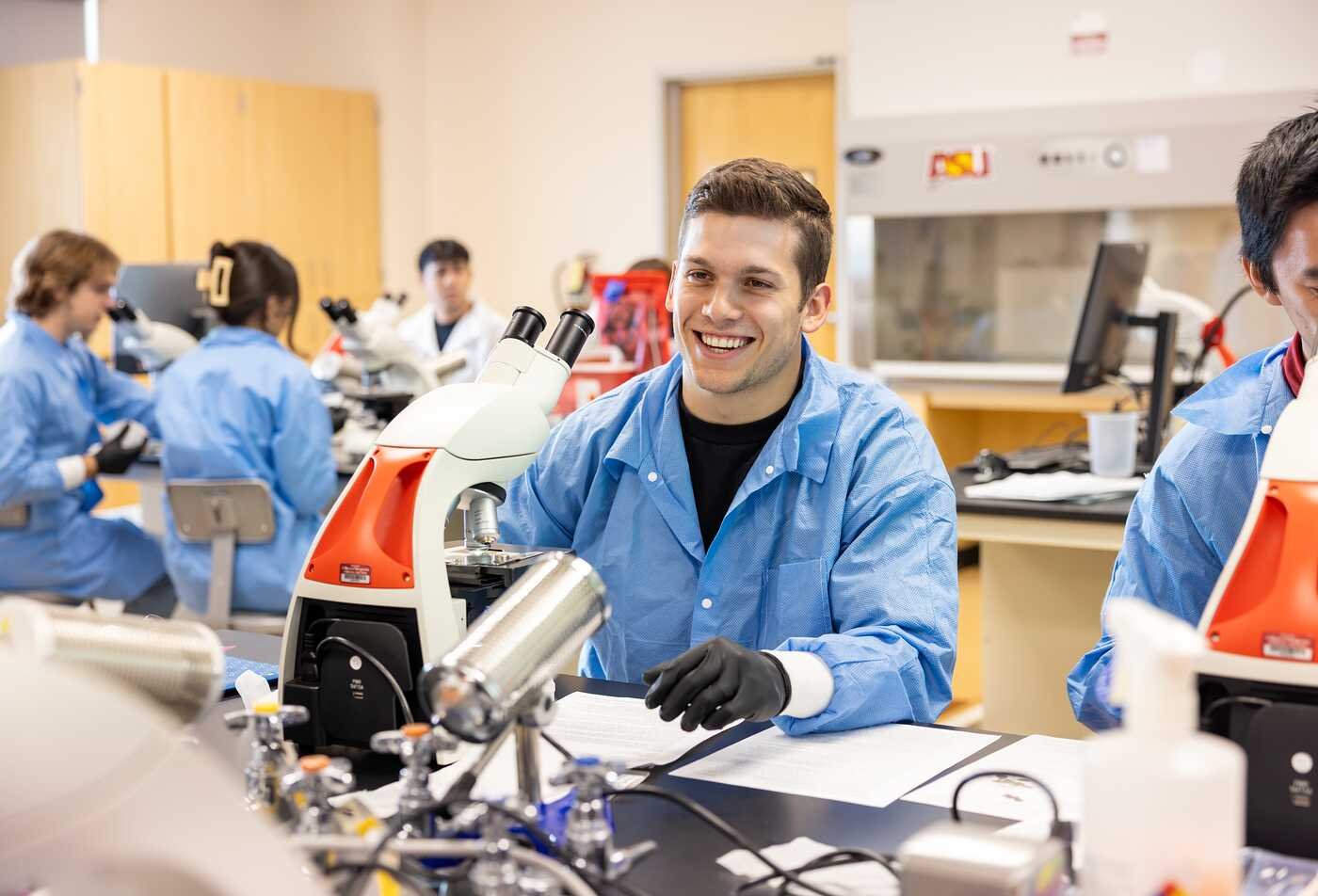
You gain more than classroom knowledge through undergraduate research, community engagement, internships, lab work, field-based projects and immersive technologies such as virtual reality. These experiences connect what you learn to real-world problems and the needs of growing industries, helping you build the skills, experience and professional connections to launch your STEM career after graduation.
At ASU¿s College of Integrative Sciences and Arts, you experience an integrative, applied approach to learning that connects disciplines and puts your education to work. You graduate with practical experience and career-ready skills designed to help you move confidently from college into the workforce.
Courses
Explore a sample list of courses you may take in this program.
| Sample courses |
|---|
| IDS 301 Becoming Interdisciplinary |
| ABS 350 Applied Statistics |
| ACO 100 All About Data: Design, Query, and Visualization |
| IDS 401 Integration: Experiential Learning |
| ECN 221 Business Statistics |
| ACO 102 Object-Oriented Programming |

Course checksheet and curriculum archive
The curriculum checksheet displays this program's required courses and other requirements you must complete for graduation.
Current ASU students, see how your courses can apply to another major and find out how to change your major (opens in new window).


Already completed some college courses? Build on your success.
If you earned college credit outside ASU, our transfer tools map out your progress towards a degree and help you plan next steps.
See how your credits may apply (opens in new window)Admission requirements
Here are the admission and application details
All students are required to meet general university admission requirements.
First year (opens in new window) | Transfer (opens in new window) | International (opens in new window) | Readmission (opens in new window)
A current ASU student has no additional requirements for changing majors.
Students should visit the Change of Major form (opens in new window) for information about how to change a major to this program.
Explore expanded study opportunities
When you pursue concurrent degrees (also known as a “double major”), you earn two distinct degrees and receive two diplomas. Working with your academic advisor, you can create your own concurrent degree combination. Some combinations are not possible due to high levels of overlap in curriculum.
With more than 300 Global Education programs available to them, students are able to tailor their experience to their specific interests and skill sets. Students in applied quantitative science are able to gain hands-on experience in a variety of countries around the world. Graduates who have the heightened cultural competency and strengthened leadership and critical thinking skills they acquired through study abroad may stand out in a competitive field.


Paying for college
Use our calculator to estimate your full-time or part-time tuition fees for this program prior to any financial aid. Keep in mind that most of our students recieve financial aid, which can reduce out-of-pocket costs.
Get an estimate


Build the career and future you want
Our graduates are prepared for a variety of career paths, including:
| Career | Growth | Median Salary | More Information |
|---|---|---|---|
| Business Intelligence Analyst | 34.6% | $120,230 | Learn more |
| Document Management Specialist | 5.1% | $116,580 | Learn more |
| Mathematical Science Assistant | 7.1% | $81,490 | Learn more |
| Quality Control Technician | 4.4% | $62,280 | Learn more |
| Supply Chain Manager | 6.1% | $107,230 | Learn more |
Example job titles and salaries listed are not necessarily entry level, and students should take into consideration how years of experience and geographical location may affect pay scales. Some jobs also may require advanced degrees, certifications or state-specific licensure.
Data obtained from the Occupational Information Network (O*NET) under sponsorship of the U.S. Department of Labor/Employment and Training Administration (USDOL/ETA).
More about careers
Careers this applied quantitative science degree prepares you for
Employers are increasingly seeking candidates who know how to use quantitative information, and graduates of this program are well equipped with the skills and knowledge to meet that demand. People who work in any business or industry use quantitative skills to solve problems.
Contact information
Use the contact information below to get in touch if you're a current student or have general questions.
Prospective students should fill out the Request for Information form.
School of Applied Sciences and Arts
|
SANCA 233
CISA@asu.edu
480-727-1526
Frequently asked questions about degree programs
Accelerated programs allow students the opportunity to expedite the completion of their degree.
Accelerated master's
These programs allow students to accelerate their studies to earn a bachelor's plus a master's degree in as few as five years (for some programs).
Each program has requirements students must meet to be eligible for consideration. Students typically receive approval to pursue the accelerated master's during the junior year of their bachelor's degree program. Interested students can learn about eligibility requirements and how to apply.
Concurrent degrees allow students to pursue their own personal or professional interests, earn two distinct degrees and receive two diplomas. To add a concurrent degree to your existing degree, work with your academic advisor.
Joint programs, or jointly conferred degrees, are offered by more than one college and provide opportunities for students to take advantage of the academic strengths of two academic units. Upon graduation, students are awarded one degree and one diploma conferred by two colleges.
ASU adds new programs to Degree Search frequently. Come back often and look for the "New Programs" option.
ASU Online offers programs in an entirely online format with multiple enrollment sessions throughout the year. See https://asuonline.asu.edu/ for more information.
