

Nursing, BSN
Develop expertise in evidence-based practice, clinical reasoning, innovation, interprofessional communication and information technology across multiple pathways. Enter this nursing degree in the way that best fits your background and goals.
Quick facts

Locations


Courses

Additional facts
STEM-OPT extension eligible: No
International students (F1), this program is not eligible for the STEM-OPT extension.
Accreditation and professional licensure
The BSN in Nursing at Arizona State University is accredited by the Co...
Accredited by the Higher Learning Commission.
The accelerated BSN/MS option is currently only available to ASU Online students.


Nursing, BSN degree description
Achieving a Bachelor of Science in Nursing is possible through various distinctive pathways.
Prelicensure Clinical Nursing Programs
ASU offers programs if you wish to become a registered nurse (or RN) by completing a BSN. Programs are full-time and include didactic lecture courses, experiential learning, and clinical experiences. You must complete prerequisite courses and apply for advancement to the program. Upon graduation, you will be eligible to sit for the National Council Licensure Examination.
You advance in one of two ways: direct admission or competitive advancement. Direct admission is offered if you are an incoming first-year student from a high school that meets specific admission criteria. If you are admitted directly, you must meet continuing eligibility criteria while attending ASU to advance into a nursing program. In other cases, --- including if you are a first-year student who does not meet direct admission criteria, you are a direct admission student who does not meet continuing eligibility criteria, you are a transfer student, you are a second degree student, or you are an ASU student who is changing majors --- you may apply for advancement as a competitive applicant for any remaining spaces.
Program options:
- Traditional BSN: a four-semester program with three starts per year: fall, spring, and summer (cohorts vary by campus). Depending on the cohort, the program may be completed in a 16-month year-round or 24-month academic year schedule.
- Accelerated BSN: a three-semester year-round program (12-month) with two starts per year: fall and spring (cohorts vary by campus). Priority is given to if you are a student with an earned bachelor's degree seeking an additional degree.
- Learn Where You Live: an accelerated 12-month option if you're looking for a more accessible and affordable prelicensure nursing program in Arizona. This program includes a blend of live sessions via ASU Sync*, in-person clinical and lab experiences, and self-directed studying.
RN to BSN and Concurrent Enrollment Programs
ASU offers online options to complete a BSN if you are a nursing transfer student. There are five starts per year: two in fall, two in spring and one in summer. Transfer pathway agreements are in place with community college nursing programs, providing additional benefits to you. These programs are not available if you reside in Tennessee or Washington.
- RN to BSN: available if you have an associate degree in nursing and a current RN license in good standing with a state board of nursing. Courses are offered online in 7.5-week sessions and can be completed in as little as 14 months.
- Concurrent Enrollment Program: available if you're admitted to or enrolled in a regionally accredited associate degree nursing program. If you are a qualified student, you can enroll in ASU courses and earn your BSN while simultaneously pursuing your associate degree in nursing. ASU courses are delivered online in 15-week sessions.
*If you have F-1 or J-1 immigration status, you should speak with an advisor about other options to complete this program. Students with F-1 or J-1 immigration status are not permitted to complete courses via Sync.
If you seek to use GI Bill® benefits for ASU Sync programs, you should contact the Pat Tillman Veterans Center regarding certain limitations. GI Bill® is a registered trademark of the U.S. Department of Veterans Affairs. More information about education benefits offered by VA is available on the official U.S. government website at www.benefits.va.gov/gibill.
Why study nursing at ASU?
The range of entry paths for obtaining this degree is rare to find within a single BSN offering. Across the BSN pathways, you can build skills in critical thinking, professional communication, leadership, quality improvement, collaboration, cultural competence, resilience and self-directed learning. The RN-BSN and CEP curricula also emphasize health policy, interprofessional collaboration, and culturally responsive care.
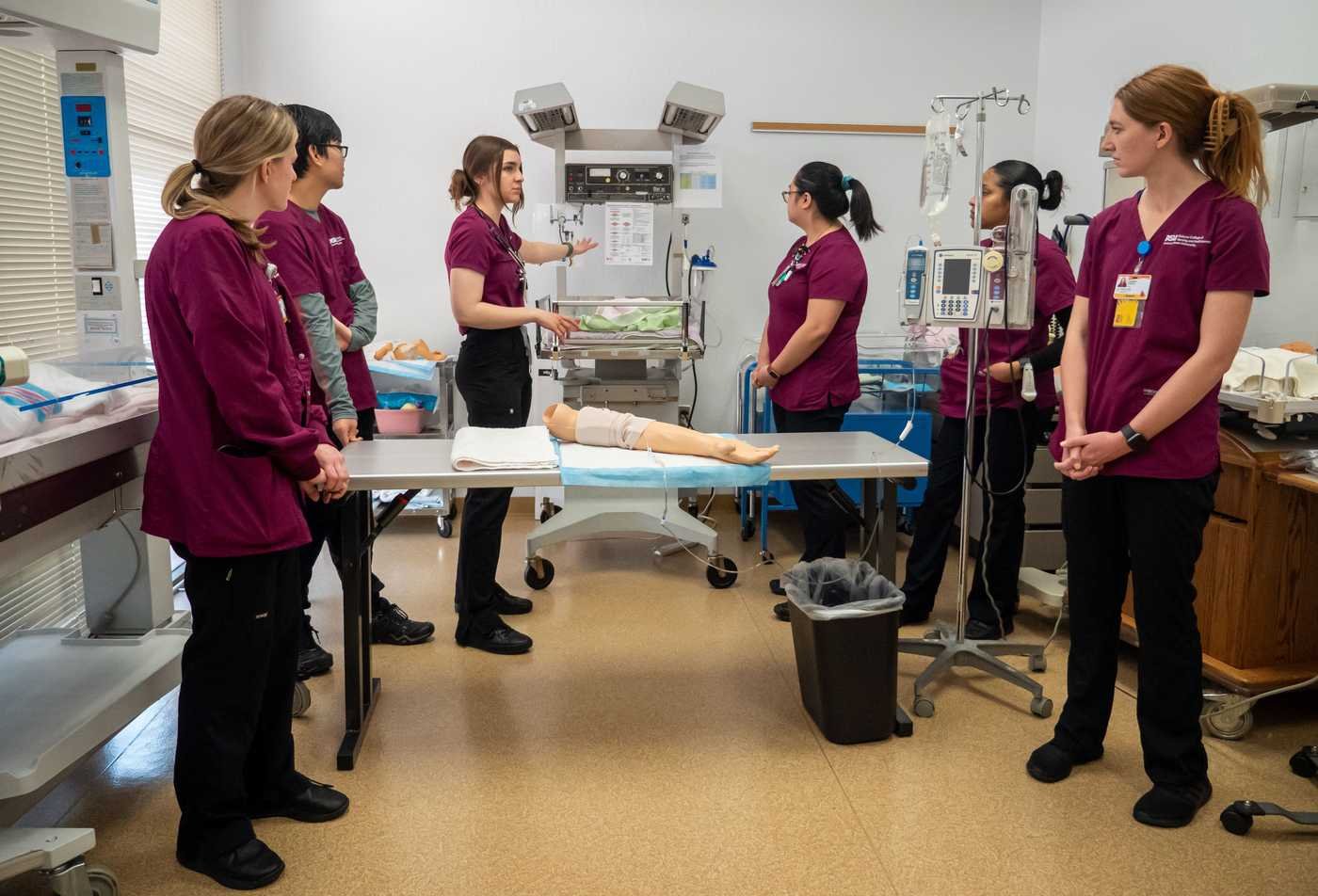
The prelicensure programs include hands-on experience through clinical teams, learning communities, and a final Transition to Practice experience. The RN to BSN pathway features community health and capstone clinical practice experiences that can be completed in your local communities and workplaces.
Courses
Course checksheet and curriculum archive
The curriculum checksheet displays this program's required courses and other requirements you must complete for graduation.
Current ASU students, see how your courses can apply to another major and find out how to change your major (opens in new window).


Already completed some college courses? Build on your success.
If you earned college credit outside ASU, our transfer tools map out your progress towards a degree and help you plan next steps.
See how your credits may apply (opens in new window)What you'll learn
The following learning outcomes highlight some of the knowledge and skills you'll develop to support your future success.
- Implement safety and quality principles to minimize risk and enhance patient outcomes through system effectiveness and individual accountability.
- Deliver collaborative population health interventions aimed at prevention, health promotion, and disease management to promote equitable population health outcomes.
- Evaluate evidence-based nursing knowledge to enhance nursing care delivery, improve health, and transform health care.
 Implement safety and quality principles to minimize risk and enhance patient outcomes through system effectiveness and individual accountability.
Admission requirements
Here are the admission and application details
All students are required to meet general university admission requirements.
First year (opens in new window) | Transfer (opens in new window) | International (opens in new window) | Readmission (opens in new window)
The admission standards for majors in the Edson College of Nursing and Health Innovation are higher than minimum university standards. Effective fall 2022, first-year admission requirements are: Priority application date: November 1 First-year applicants should select an additional major when applying for admission. English language proficiency requirements for applicants whose native language is not English: total TOEFL iBT score of 4 with a minimum section score of 3.5 (Reading: 3.5, Writing: 3.5, Listening: 3.5, Speaking: 3.5.), or 76 (taken at a testing center) if taken before January 21, 2026; or a minimum IELTS score of 6.5; or a minimum Duolingo English test score of 100; or a minimum Cambridge English exam score of 176. First-year admission applications to the Bachelor of Science in Nursing program that are received after the November 1 application priority date are considered on a space-available basis. Students not offered admission directly to the nursing program are placed in the BS program in community health.
Current ASU students interested in changing to this program need to apply for the upper-division clinical nursing program through an advancement application process. Space is limited, and selection is based upon GPA and the score earned on the TEAS. Students should speak with an advisor in the Edson College of Nursing and Health Innovation for more information on how to change a major to this program.
Students should visit the Change of Major form (opens in new window) for information about how to change a major to this program.
Explore expanded study opportunities
This program allows you to obtain both a bachelor's and a master's degree in as little as five years. As a high-achieving student, accelerated bachelor's plus master's degree programs are designed for you to share undergraduate coursework with graduate coursework to accelerate completion of your master's degree. These programs feature the same high-quality curriculum taught by ASU's world-renowned faculty.
This program is offered as an accelerated bachelor's plus master's degree with:
Approval to pursue the accelerated master's is typically granted during the junior year of your bachelor's degree program. If you are interested, you can learn more about eligibility requirements and how to apply.
When you pursue concurrent degrees (also known as a “double major”), you earn two distinct degrees and receive two diplomas. Working with your academic advisor, you can create your own concurrent degree combination. Some combinations are not possible due to high levels of overlap in curriculum.
Through study abroad, students majoring in nursing are able to expand their knowledge of how nursing is practiced across the globe.
With more than 300 programs available, students can tailor their experience to their interests and skill sets. The heightened cultural competency, leadership and critical-thinking skills they achieve enhance their resumes and are applicable in any career choice.


Paying for college
Use our calculator to estimate your full-time or part-time tuition fees for this program prior to any financial aid. Keep in mind that most of our students receive financial aid, which can reduce out-of-pocket costs.
Get an estimate


Build the career and future you want
Our graduates are prepared for a variety of career paths, including:
| Career | Growth | Median Salary | More Information |
|---|---|---|---|
| Certified Nurse Assistant (CNA) | 2.6% | $42,260 | Learn more |
| Clinical Nurse Specialist | 5.6% | $97,550 | Learn more |
| Critical Care Nurse | 5.6% | $97,550 | Learn more |
| Intensive Care Nurse | 5.6% | $97,550 | Learn more |
| Licensed Vocational Nurse (LVN) | 3.0% | $64,400 | Learn more |
| Nurse Anesthetist | 9.7% | $236,590 | Learn more |
| Nurse Midwife | 11.5% | $134,040 | Learn more |
| Nurse Practitioner | 41.0% | $132,300 | Learn more |
| Psychiatric Nurse | 5.6% | $97,550 | Learn more |
| Registered Nurse (RN) | 5.6% | $97,550 | Learn more |
Example job titles and salaries listed are not necessarily entry level, and students should take into consideration how years of experience and geographical location may affect pay scales. Some jobs also may require advanced degrees, certifications or state-specific licensure.
Data obtained from the Occupational Information Network (O*NET) under sponsorship of the U.S. Department of Labor/Employment and Training Administration (USDOL/ETA).
More about careers
Careers this nursing degree prepares you for
The Edson College of Nursing and Health Innovation prepares graduates for excellence upon entering the workplace. Graduates deliver nursing care to individuals, families and communities. Completion of this degree program also prepares individuals for entrance into graduate study in nursing at the master's or doctoral degree levels, which is essential for teaching, administration, clinical specialization and research.
Contact information
Use the contact information below to get in touch if you're a current student or have general questions.
Prospective students should fill out the Request for Information form.
Edson College of Nursing and Health Innovation
|
HLTHN 301
asu.bsn@asu.edu
602-496-0937
Frequently asked questions about degree programs
Accelerated programs allow students the opportunity to expedite the completion of their degree.
Accelerated master's
These programs allow students to accelerate their studies to earn a bachelor's plus a master's degree in as few as five years (for some programs).
Each program has requirements students must meet to be eligible for consideration. Students typically receive approval to pursue the accelerated master's during the junior year of their bachelor's degree program. Interested students can learn about eligibility requirements and how to apply.
Concurrent degrees allow students to pursue their own personal or professional interests, earn two distinct degrees and receive two diplomas. To add a concurrent degree to your existing degree, work with your academic advisor.
Joint programs, or jointly conferred degrees, are offered by more than one college and provide opportunities for students to take advantage of the academic strengths of two academic units. Upon graduation, students are awarded one degree and one diploma conferred by two colleges.
ASU adds new programs to Degree Search frequently. Come back often and look for the "New Programs" option.
ASU Online offers programs in an entirely online format with multiple enrollment sessions throughout the year. See https://asuonline.asu.edu/ for more information.
