

Biomedical Informatics and Data Science, PhD
Become a leader at the intersection of health care, data science, artificial intelligence and biomedical research. Gain advanced skills in analytics, machine learning, health information systems and research methods to enter high-demand careers across biotechnology, pharmaceuticals, government and technology.
Quick facts

Locations


Credits
Additional facts
STEM-OPT extension eligible: Yes
International students (F1) can extend U.S. work experience by 24 months.
Accreditation
Accredited by the Higher Learning Commission.


Biomedical Informatics and Data Science, PhD degree description
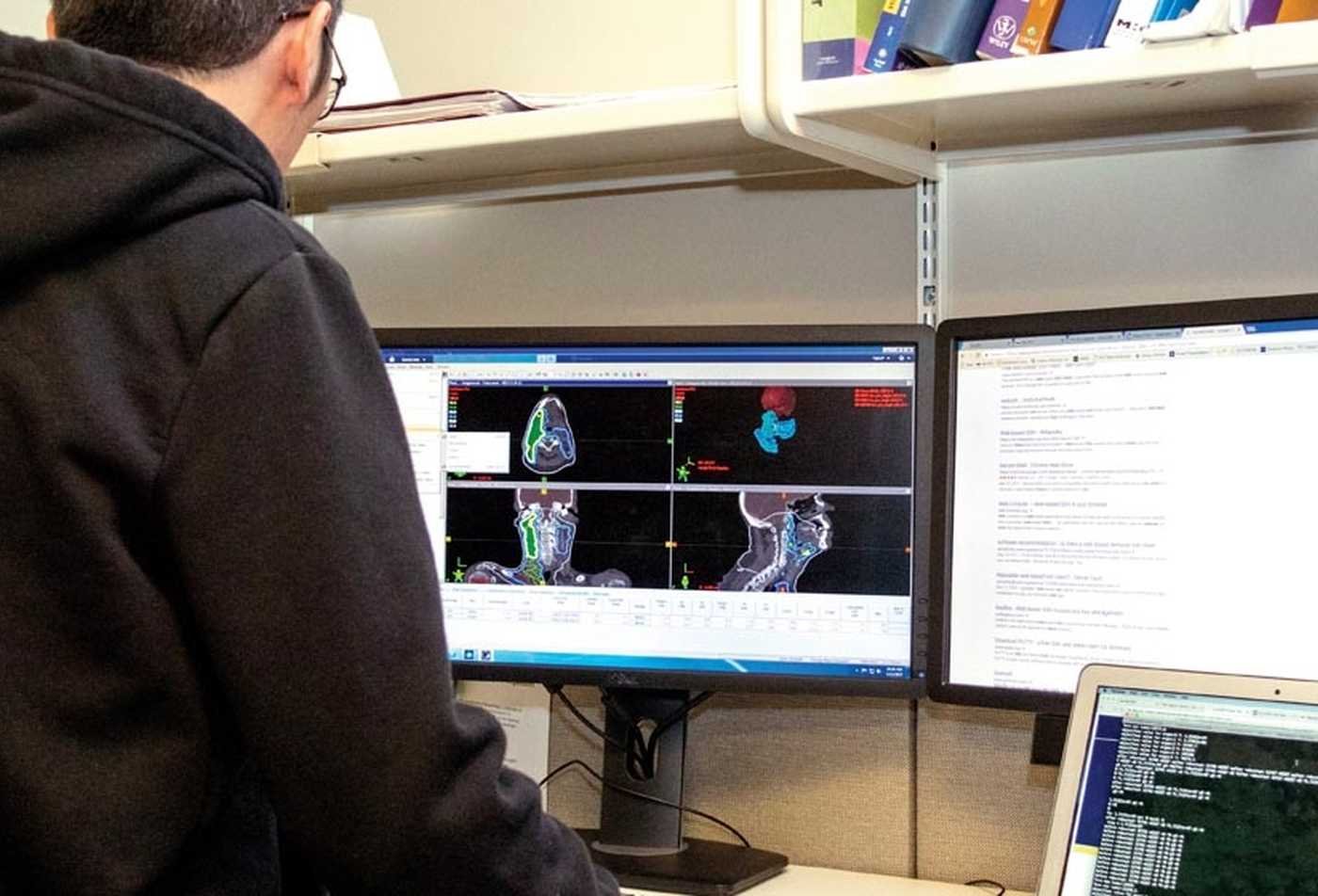
The Doctor of Philosophy program in biomedical informatics and data science enables you to develop expertise in areas such as bioinformatics, clinical informatics, population health management, imaging and biomedical data science.
This program fosters collaboration among academic researchers, health care providers and industry partners and allows you to apply new developments in informatics theory to clinical practice, biomedical research and public health. You may also explore cross-cutting areas such as artificial intelligence and digital health.
You learn at the leading edge of the field through specialized coursework in an area of focus and independent research. The program fosters strong collaborative relationships with a variety of health care organizations, the bioscience industry and governmental agencies, providing an unparalleled opportunity for you to explore and contribute to advances in biomedical informatics and data science
You should note that some courses and faculty offices are located at the Health Futures Center in North Phoenix.
Why earn your biomedical informatics and data science PhD at ASU?
At ASU, you join a university known for innovation, interdisciplinary collaboration and research that drives meaningful societal impact. The College of Health Solutions tackles health challenges from a solutions-oriented angle, uniting experts across health care, technology, engineering, data science and public health.
Curriculum
This graduate degree includes courses focused on a specialized topic, so you can advance your skills for further professional opportunities. Explore all courses below:
84 credit hours, a written comprehensive exam, an oral comprehensive exam, a prospectus and a dissertation
Required Core (22 credit hours) Electives (32 credit hours) Research (18 credit hours) Culminating Experience (12 credit hours) Additional Curriculum Information BMI 504 requires in-person observations within local health clinics. To conduct clinical observations, students must meet additional requirements prior to course enrollment, which typically include proof of vaccination, fingerprint clearance and background check, and a drug test. BMI 560 and BMI 570 should be taken twice for one credit hour each time.
BMI 502 Foundations of Biomedical Informatics Methods I (3)
BMI 504 Introduction to Clinical Environments (3)
BMI 505 Foundations of Biomedical Informatics Methods II (3)
BMI 540 Problem Solving in Biomedical Informatics (3)
BMI 560 Teaching in Biomedical Informatics (2)
BMI 570 BMI Symposium (2)
BMI 601 Fundamentals of Health Informatics (3)
BST 515 Applied Biostatistics in Medicine and Informatics (3)
BMI 792 Research (18)
BMI 799 Dissertation (12)
Students entering the doctoral program with a master's degree in a related discipline may count up to 30 credit hours from the master's degree toward the total credit hours, with program approval.








What you'll learn
The following learning outcomes highlight some of the knowledge and skills you'll develop to support your future success.
- Generate designs to solve biomedical informatics and data science problems.
- Apply theories, typology, frameworks, representations, methods and processes used in different contexts of biomedical informatics and data science.
- Create new knowledge, including theories, typologies, frameworks, representations, methods and processes, to address biomedical informatics and data science problems.
 Generate designs to solve biomedical informatics and data science problems.
Admission requirements
Here are the admission and application details
All students are required to meet general university admission requirements.
U.S. applicants (opens in new window) | International applicants (opens in new window) | English proficiency (opens in new window)
Applicants must fulfill the requirements of both the Graduate College and the College of Health Solutions. Applicants are eligible to apply to the program if they have earned a bachelor's or master's degree from a regionally accredited institution. Applicants must have a minimum cumulative GPA of 3.00 (scale is 4.00 = "A") in the last 60 hours of their first bachelor's degree program or a minimum cumulative GPA of 3.00 (scale is 4.00 = "A") in an applicable master's degree program. All applicants must submit: Additional Application Information Prior bachelor's or master's degrees in biology, computer science, engineering or statistics, or postbaccalaureate training as a health professional in medicine, nursing or pharmacy is preferred. Applicants who have earned degrees in other unrelated fields with appropriate academic backgrounds are also considered. All applicants must have basic competencies in general biology (BIO 181 or equivalent), statistics (HCD 300 or STP 226 or equivalent) and computer programming (BMI 110 or CSE 110 or equivalent). The statement of purpose should be one to two pages and indicate the applicant's interest in the program, knowledge of the field and career plans. Applicants are encouraged to connect with program faculty who could be potential research mentors and include this information in their statement if it is available at the time of application. To accommodate students' diverse backgrounds, the applicant is asked to describe their educational and professional background in the following areas: computer science, decision sciences, artificial intelligence, statistics and mathematics, biological sciences and health sciences. This essay should be no longer than one page. Contact information of three references is required. References are contacted via email to submit a letter of recommendation and respond to a series of questions about the applicant.
An applicant whose native language is not English must provide proof of English proficiency regardless of their current residency.
Application deadlines
| Session | Modality | Deadline | Type |
|---|---|---|---|
| Session A/C | In Person | 12/01 | Priority* |
*A priority deadline means that applications submitted and completed before the priority deadline will receive priority consideration. Applications submitted after the priority deadlines will be reviewed in the order in which they were completed and on a space-available basis. An application is complete after all materials are received by Admission Services.


Paying for college
Use our calculator to estimate your full-time or part-time tuition fees for this program prior to any financial aid. Keep in mind that most of our students receive financial aid, which can reduce out-of-pocket costs.
Get an estimateCareer opportunities
Careers this biomedical informatics and data science PhD degree prepares you for
Professionals with advanced training in biomedical informatics and data science are in high demand across a variety of sectors and industries, including academic institutions, not-for-profit research institutes, and governmental and public health agencies and health care organizations, as well as the information technology, biotech and pharmaceutical industries.
Career examples include:
- bioinformatics scientist
- biostatistician
- data scientist
- deep learning engineer
- public health informatics scientist
- research scientist
- senior analyst
- software engineer
- university faculty


Contact information
Use the contact information below to get in touch if you're a current student or have general questions.
Prospective students should fill out the Request for Information form.
School of Health Systems Transformation
|
HLTHN 401AA
CHSGrad@asu.edu
602-496-3300
Frequently asked questions about degree programs
Accelerated programs allow students the opportunity to expedite the completion of their degree.
Accelerated master's
These programs allow students to accelerate their studies to earn a bachelor's plus a master's degree in as few as five years (for some programs).
Each program has requirements students must meet to be eligible for consideration. Students typically receive approval to pursue the accelerated master's during the junior year of their bachelor's degree program. Interested students can learn about eligibility requirements and how to apply.
Concurrent degrees allow students to pursue their own personal or professional interests, earn two distinct degrees and receive two diplomas. To add a concurrent degree to your existing degree, work with your academic advisor.
Joint programs, or jointly conferred degrees, are offered by more than one college and provide opportunities for students to take advantage of the academic strengths of two academic units. Upon graduation, students are awarded one degree and one diploma conferred by two colleges.
ASU adds new programs to Degree Search frequently. Come back often and look for the "New Programs" option.
ASU Online offers programs in an entirely online format with multiple enrollment sessions throughout the year. See https://asuonline.asu.edu/ for more information.
The Western Regional Graduate Program (WRGP) provides a reduced tuition rate to non-resident graduate students who qualify. Visit the WRGP/WICHE webpage for more information: https://graduate.asu.edu/wiche.
