

Environmental Engineering, MS
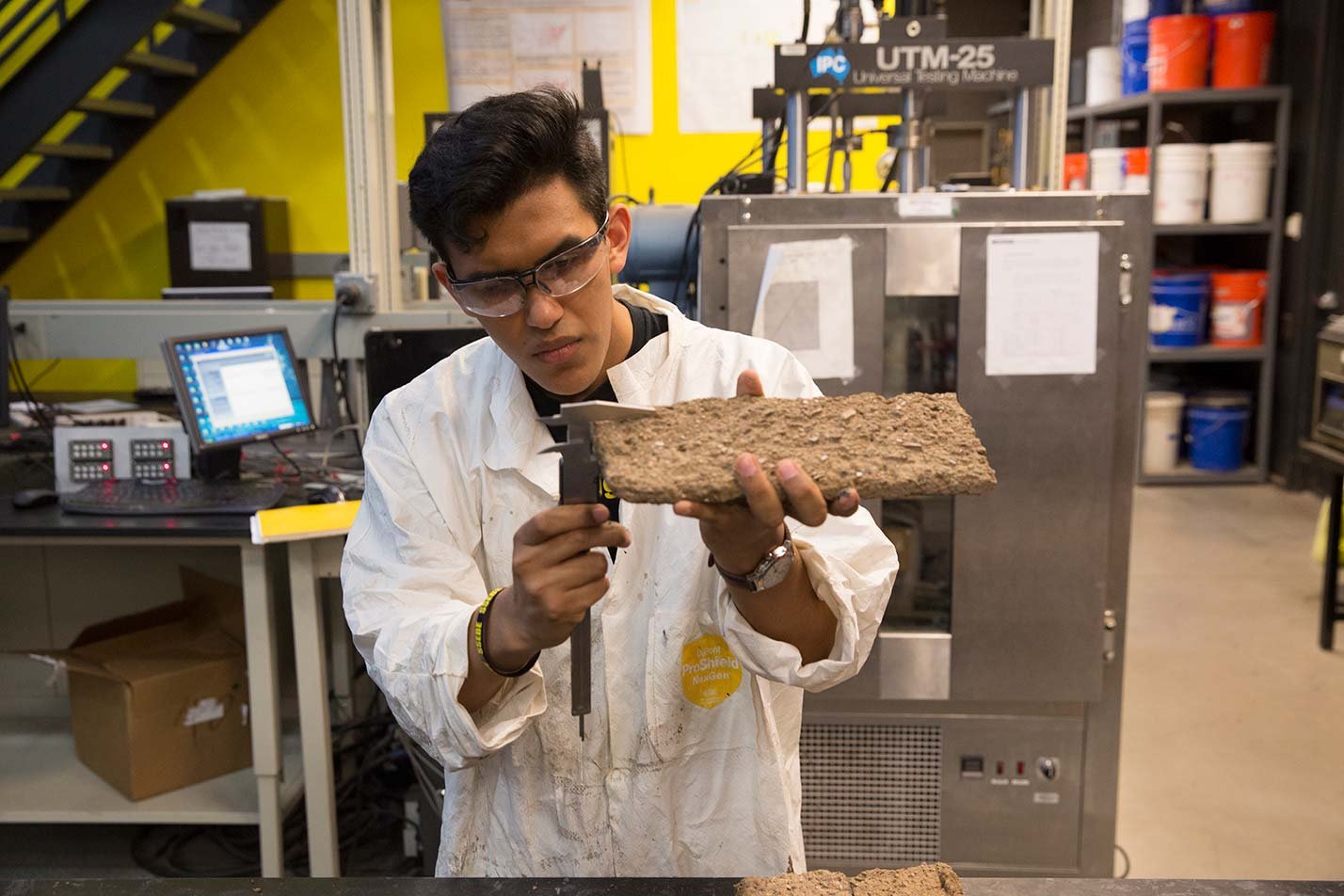
Do you want to learn how environmental engineers create solutions for society's most pressing challenges? This is your opportunity to take courses and participate in research with faculty experts in water quality, water treatment and reuse, biotechnology, nanotechnology and emerging topics.
Quick facts

Locations


Credits
Additional facts
STEM-OPT extension eligible: Yes
International students (F1) can extend U.S. work experience by 24 months.
Accreditation
Accredited by the Higher Learning Commission.


Degree description
If you have a background in agricultural, biological, chemical, civil or natural sciences such as chemistry, ecology or geology related fields, the Master of Science program in environmental engineering is designed for you.
You gain advanced knowledge that can be applied when addressing grand challenges facing society, such as how to supply clean water and safe food, design a future without pollution, recover valuable resources from waste, and create healthy and smart cities.
As an environmental engineer, you study nanotechnology, biotechnology and sustainable engineering.
Curriculum
This graduate degree includes courses focused on a specialized topic, so you can advance your skills for further professional opportunities. Explore all courses below.
30 credit hours - course-based master's, or
30 credit hours and a thesis, or
30 credit hours including the required applied project course (EVE 593)
COURSE-BASED OPTION Required Core (12 credit hours) Electives or Research (12 credit hours) Other Requirements (6 credit hours) OPTIONS WITH CULMINATING EXPERIENCE Required Core (12 credit hours) Electives or Research (6 or 9 credit hours) Other Requirements (6 credit hours) Culminating Experience (3 or 6 credit hours) Additional Curriculum Information Regardless of the culminating experience chosen, all students in the program complete six credit hours from the Other Requirements course list; courses on this list may be substituted with approval of the academic unit.
CEE 561 Physical-chemical Treatment of Water (3)
CEE 562 Biological Wastewater Treatment (3)
CEE 563 Environmental Engineering Chemistry (3)
CEE 567 Environmental Health Microbiology (3)
CEE 560 Soil and Groundwater Remediation (3)
CEE 564 Contaminant Fate and Transport (3)
EVE 568 Environmental Risk Assessment (3)
EVE 571 Advanced Water Quality Modeling and Treatment (3)
CEE 561 Physical-chemical Treatment of Water (3)
CEE 562 Biological Wastewater Treatment (3)
CEE 563 Environmental Engineering Chemistry (3)
CEE 567 Environmental Health Microbiology (3)
CEE 560 Soil and Groundwater Remediation (3)
CEE 564 Contaminant Fate and Transport (3)
EVE 568 Environmental Risk Assessment (3)
EVE 571 Advanced Water Quality Modeling and Treatment (3)
EVE 593 Applied Project (3) or
EVE 599 Thesis (6)
The master's degree offers a course-based option that is recommended for students seeking a broader exposure to topics through coursework. Students seeking specialization and research experience would complete a thesis. Students wanting exposure to research methods, such as data collection, would complete an applied project.


Admission requirements
Here are the admission and application details
All students are required to meet general university admission requirements.
U.S. applicants (opens in new window) | International applicants (opens in new window) | English proficiency (opens in new window)
Applicants must fulfill the requirements of both the Graduate College and the Ira A. Fulton Schools of Engineering. Applicants are eligible to apply if they have earned a bachelor's or master's degree in environmental engineering, chemical engineering, civil engineering, agricultural engineering, biological engineering or a related field from a regionally accredited institution. Applicants must have a minimum cumulative GPA of 3.00 (scale is 4.00 = "A") in the last 60 hours of their first bachelor's degree program or a minimum cumulative GPA of 3.00 (scale is 4.00 = "A") in an applicable master's degree program. Applicants are required to submit: Additional Application Information Those seeking a teaching assistantship must demonstrate proficiency in spoken English with a score of 55 or higher on the Speaking Proficiency English Assessment Kit or a score of 26 on the speaking portion of the TOEFL. The student's credentials for admission are evaluated by the graduate program chair. A student whose undergraduate degree is not in environmental engineering or a related field is required to take appropriate undergraduate courses to establish a base of knowledge in the discipline. These additional courses required for admission to the graduate degree program are specified at the time of admission. Applicants are strongly encouraged to submit a professional resume and personal statement.
An applicant whose native language is not English must provide proof of English proficiency regardless of their current residency.
Explore expanded study opportunities
This program allows you to obtain both a bachelor's and a master's degree in as little as five years. As a high-achieving student, accelerated bachelor's plus master's degree programs are designed for you to share undergraduate coursework with graduate coursework to accelerate completion of your master's degree. These programs feature the same high-quality curriculum taught by ASU's world-renowned faculty.
This program is offered as an accelerated bachelor's plus master's degree with:
Approval to pursue the accelerated master's is typically granted during the junior year of your bachelor's degree program. If you are interested, you can learn more about eligibility requirements and how to apply.


Paying for college
Use our calculator to estimate your full-time or part-time tuition fees for this program prior to any financial aid. Keep in mind that most of our students receive financial aid, which can reduce out-of-pocket costs.
Get an estimateCareer opportunities
Graduates with a master's degree in environmental engineering are employed in engineering consulting companies, private industry, local and federal government, and nongovernmental organizations.

Contact information
Use the contact information below to get in touch if you're a current student or have general questions.
Prospective students should fill out the Request for Information form.
School of Sustainable Engineering & Built Envirnmt
|
HLMK 437
sebe.advising@asu.edu
480-965-0595
Frequently asked questions about degree programs
Accelerated programs allow students the opportunity to expedite the completion of their degree.
Accelerated master's
These programs allow students to accelerate their studies to earn a bachelor's plus a master's degree in as few as five years (for some programs).
Each program has requirements students must meet to be eligible for consideration. Students typically receive approval to pursue the accelerated master's during the junior year of their bachelor's degree program. Interested students can learn about eligibility requirements and how to apply.
Concurrent degrees allow students to pursue their own personal or professional interests, earn two distinct degrees and receive two diplomas. To add a concurrent degree to your existing degree, work with your academic advisor.
Joint programs, or jointly conferred degrees, are offered by more than one college and provide opportunities for students to take advantage of the academic strengths of two academic units. Upon graduation, students are awarded one degree and one diploma conferred by two colleges.
ASU adds new programs to Degree Search frequently. Come back often and look for the "New Programs" option.
ASU Online offers programs in an entirely online format with multiple enrollment sessions throughout the year. See https://asuonline.asu.edu/ for more information.
The Western Regional Graduate Program (WRGP) provides a reduced tuition rate to non-resident graduate students who qualify. Visit the WRGP/WICHE webpage for more information: https://graduate.asu.edu/wiche.
