

Music Composition, DMA
Sharpen advanced skills in both traditional and contemporary composition techniques, and collaborate directly with music scholars, theorists, performers, educators and fellow composers. Together, you build a well-rounded foundation that supports your professional career.
Quick facts

Locations


Credits
Additional facts
STEM-OPT extension eligible: No
International students (F1), this program is not eligible for the STEM-OPT extension.
Accreditation
Accredited by the Higher Learning Commission.


Music Composition, DMA degree description
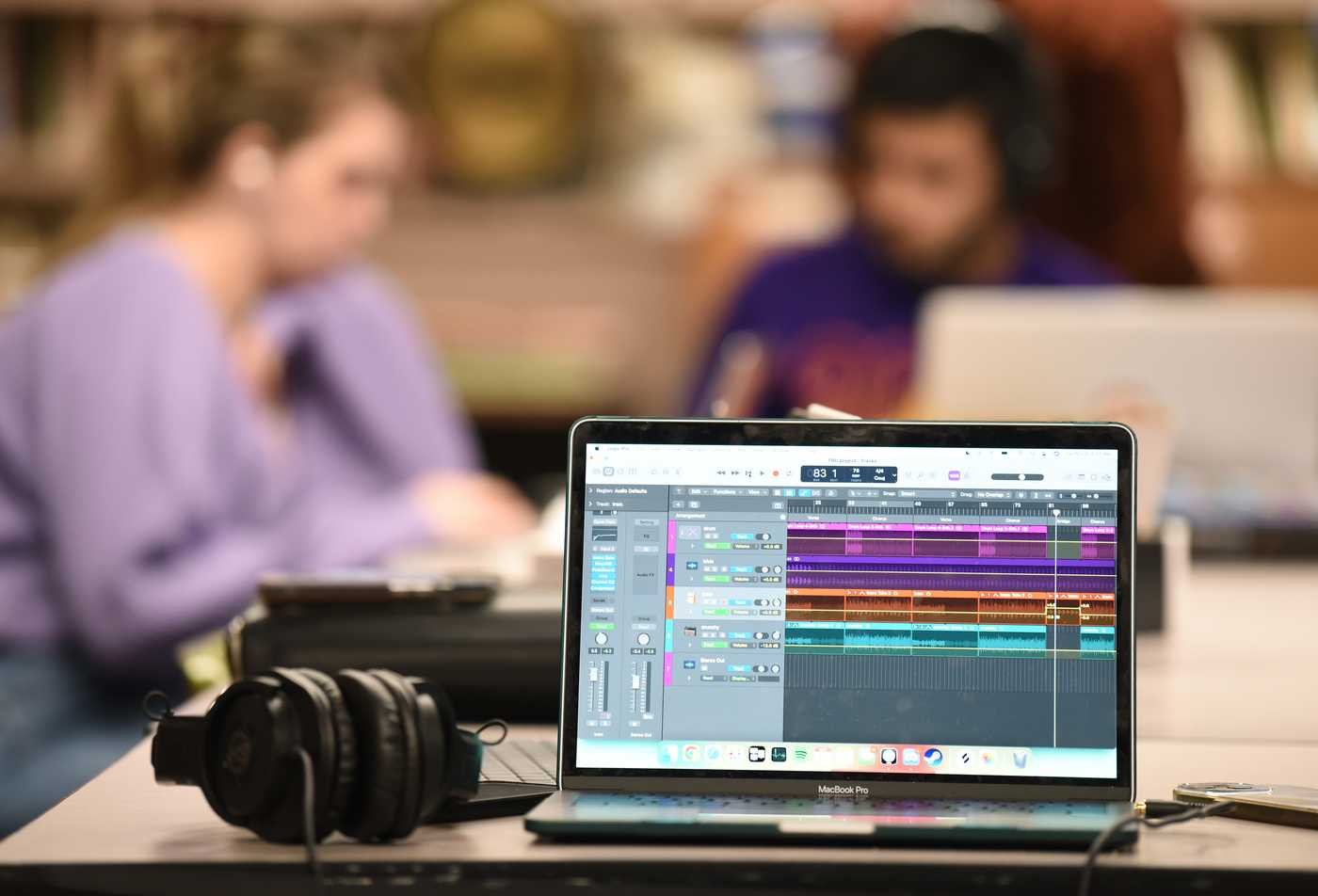
The Doctor of Musical Arts program in music with a concentration in music composition is a comprehensive professional degree program if you are an outstanding student of acoustic, electronic and multimedia composition. You develop your own compositional voice and focus on your area of interest, regardless of style or aesthetics, while gaining extensive knowledge through coursework and private lessons with faculty.
You have multiple performance opportunities that include readings by the ASU Symphony Orchestra and visiting ensembles; yearlong residencies with the Wind Ensembles and the Philharmonia; commissions for the PRISMS contemporary music festival; and collaborations with student performers, animators, filmmakers and dancers.
You have extensive interaction with faculty and opportunities to develop advanced skills in compositional techniques from a wide variety of styles and traditions, with emphasis on fostering your personal approach to composition. Collaborations with music scholars, theorists, performers, educators and other composers provide you with a broad and well-rounded foundation for advanced careers in music and teaching at the university level.
Why study music composition at ASU?
Learn from internationally recognized artists, educators and scholars who guide your development as a composer. Beyond the studio, you tap into a network of alumni, internships, residencies and partnerships that reach across the arts.
Curriculum
This graduate degree includes courses focused on a specialized topic, so you can advance your skills for further professional opportunities. Explore all courses below:
90 credit hours, a foreign language exam, a written comprehensive exam, an oral comprehensive exam, a prospectus and a dissertation
The credit requirements for the degree are distributed as follows: major area (composition, music technology, electives) (36 credit hours) The music composition concentration requires the creation of a significant original work of music (considered to be a dissertation) and either two article-length research papers or a substantial paper. Additional Curriculum Requirements Thirty credit hours from a master's degree may be applied toward the 90 credit hour degree requirement. Once admitted to the program, a student is required to be enrolled continuously, excluding summer sessions, until all requirements for the degree have been fulfilled. In general, the student should expect to spend at least the equivalent of three academic years in the program beyond the master's degree. A minimum of two semesters must be spent in continuous full-time residence at ASU. At least 54 credit hours must be completed in residence at ASU. Additional information on requirements for this degree is available on the curriculum check sheet on the Music, Dance and Theatre graduate degree page.
music theory and music history (30 credit hours)
research (12 credit hours)
dissertation (12 credit hours)
Completion of diagnostic exams in musicology and music theory is required of all new graduate music students before enrollment in the School of Music, Dance and Theatre.





What you'll learn
The following learning outcomes highlight some of the knowledge and skills you'll develop to support your future success.
- Compose original works, applying theoretical understanding of musical techniques.
- Create a significant original work that integrates and synthesizes various principles of composition.
- Interpret specific musical products within the context of a specific theoretical, historical, or cultural tradition.
 Compose original works, applying theoretical understanding of musical techniques.
 Admission requirements
Here are the admission and application details
All students are required to meet general university admission requirements.
U.S. applicants (opens in new window) | International applicants (opens in new window) | English proficiency (opens in new window)
Applicants must fulfill the requirements of both the Graduate College and the Herberger Institute for Design and the Arts. Applicants must have earned a U.S. bachelor's degree or higher from a regionally accredited institution or the equivalent of a U.S. bachelor's degree from an institution in another country that is officially recognized by that country. Applicants must have achieved a minimum cumulative GPA of 3.00 (scale is 4.00 = "A") in the last 60 semester hours or 90 quarter hours of a bachelor's degree program, or a minimum cumulative GPA of 3.00 (scale is 4.00 = "A") in an applicable master's degree program. All applicants must submit: Additional Application Information Students should see the program website for application deadlines. After complete application materials have been received, including recommendation letters, transcripts and English proficiency, and review of prescreening materials, an applicant may be invited for an interview. Information about the interview can be found on the school's admission website.
An applicant whose native language is not English must provide proof of English proficiency regardless of their current residency. The School of Music, Dance and Theatre does not offer conditional admission under any circumstances. To meet English proficiency requirements, students should have a minimum TOEFL iBT® score of 4, or 80 (taken at a testing center) if taken before January 21, 2026; an IELTS overall band score of at least 6.5; or a Pearson Test of English score of at least 60.
Application deadlines
| Session | Modality | Deadline | Type |
|---|---|---|---|
| Session A/C | In Person | 12/01 | Final* |
| Session | Modality | Deadline | Type |
|---|---|---|---|
| Session A/C | In Person | 10/01 | Final* |
*A final deadline means that all applications and application materials must be received by Admission Services by the deadline date. Applications that are incomplete may not be considered after the final deadline. Applications that are submitted past the final deadline may not be considered.


Paying for college
Use our calculator to estimate your full-time or part-time tuition fees for this program prior to any financial aid. Keep in mind that most of our students receive financial aid, which can reduce out-of-pocket costs.
Get an estimateCareer opportunities
Careers this music composition degree prepares you for
The School of Music, Dance and Theatre graduate programs inspire and empower graduates to become creative leaders who transform society through music.
Musicians with expertise in performing, composing, teaching and researching, and in arts advocacy, are in high demand across many sectors. They are welcomed in many industries, including performing arts organizations, educational institutions, entertainment companies, health and wellness industries, and community arts organizations. Skills such as creativity, collaboration, innovation and entrepreneurship, as well as the focused discipline needed for success as a musician, are all highly valued by a wide variety of companies and professions.
Career examples include:
- arts administrator
- community arts advocate
- composer for film, video games or television
- performing musician
- public or community school teacher
- university professor


Contact information
Use the contact information below to get in touch if you're a current student or have general questions.
Prospective students should fill out the Request for Information form.
School of Music, Dance and Theatre
|
MUSIC E167
mdtadmissions@asu.edu
480-965-5069
Admission deadlines
Frequently asked questions about degree programs
Accelerated programs allow students the opportunity to expedite the completion of their degree.
Accelerated master's
These programs allow students to accelerate their studies to earn a bachelor's plus a master's degree in as few as five years (for some programs).
Each program has requirements students must meet to be eligible for consideration. Students typically receive approval to pursue the accelerated master's during the junior year of their bachelor's degree program. Interested students can learn about eligibility requirements and how to apply.
Concurrent degrees allow students to pursue their own personal or professional interests, earn two distinct degrees and receive two diplomas. To add a concurrent degree to your existing degree, work with your academic advisor.
Joint programs, or jointly conferred degrees, are offered by more than one college and provide opportunities for students to take advantage of the academic strengths of two academic units. Upon graduation, students are awarded one degree and one diploma conferred by two colleges.
ASU adds new programs to Degree Search frequently. Come back often and look for the "New Programs" option.
ASU Online offers programs in an entirely online format with multiple enrollment sessions throughout the year. See https://asuonline.asu.edu/ for more information.
The Western Regional Graduate Program (WRGP) provides a reduced tuition rate to non-resident graduate students who qualify. Visit the WRGP/WICHE webpage for more information: https://graduate.asu.edu/wiche.
