

Music Therapy, MM
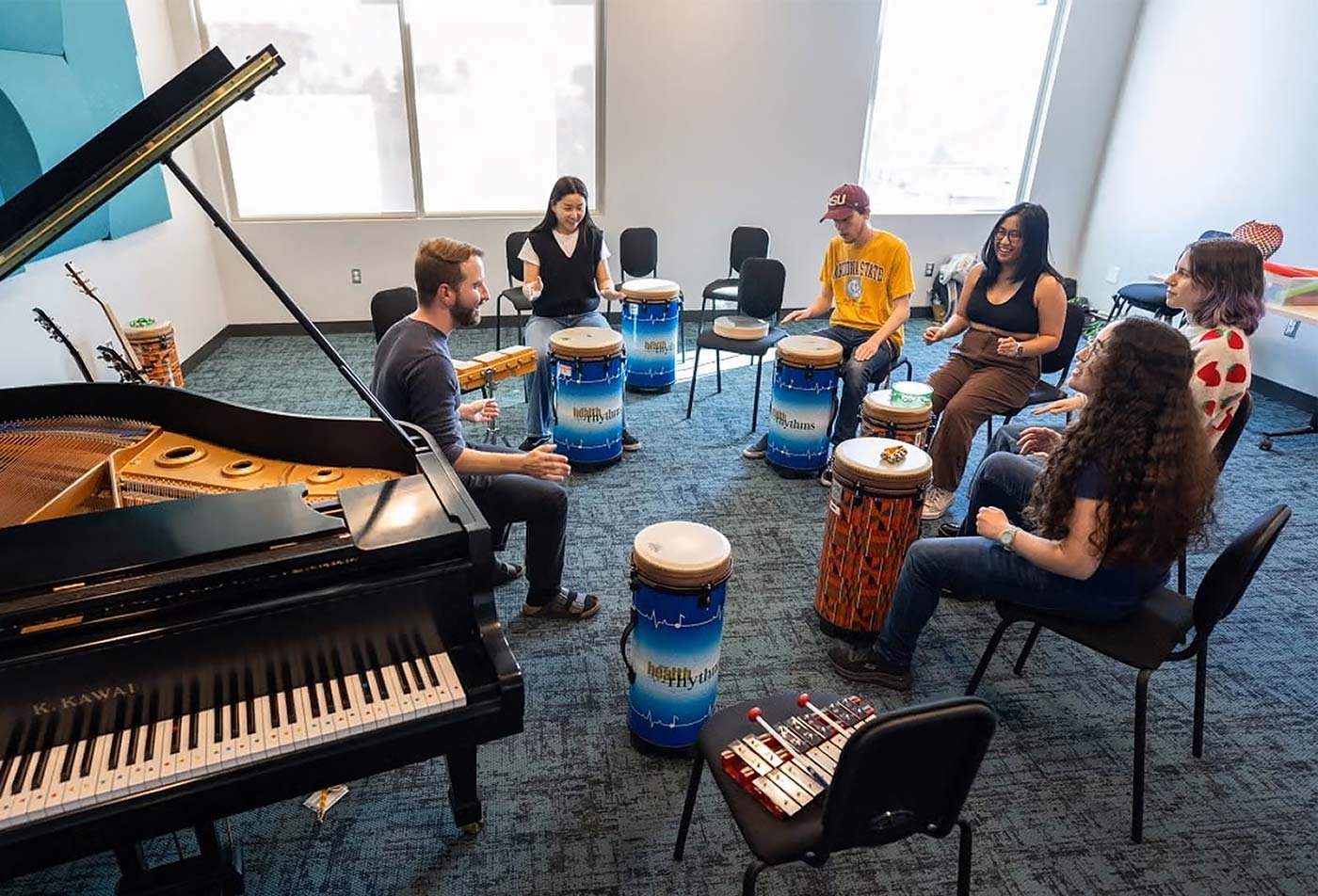
Advance your career in graduate music therapy studies whether or not you're board certified. Engage in community partnerships focused on the care of elders, young children, people who are neurodivergent and those with physical disabilities.
Quick facts

Locations


Credits
63 credit hours
Additional facts
STEM-OPT extension eligible: No
International students (F1), this program is not eligible for the STEM-OPT extension.
Accreditation and professional licensure
The American Music Therapy Association accredits Arizona State Univers...
Accredited by the Higher Learning Commission.


Music Therapy, MM degree description
The Master of Music program in music therapy provides you with rigorous studies in the theory, practice and research of music therapy.
There's a two-year track if you've completed either the undergraduate music therapy degree or its equivalent and are board-certified, or hold a similar international music therapy credential. Additionally, a three-year track is offered if you have an undergraduate degree in music but not in music therapy.
The master's degree program fosters an expanded research perspective in music therapy, emphasizing community partnerships and program development with a concentration in your area of choice, drawing from a number of possible options. Cognate areas include counseling and counseling psychology, education for people with disabilities, gerontology, social work, audiology and speech-language plus other areas.
Why study music therapy at ASU?
At the Herberger Institute for Design and the Arts, you learn from internationally recognized artists, educators and scholars who guide your growth. You perform in faculty, guest artist and student works throughout the year and you tap into a network of alumni, internships, residencies and partnerships that reach across the arts.
Curriculum
This graduate degree includes courses focused on a specialized topic, so you can advance your skills for further professional opportunities. Explore all courses below:
33 credit hours including the required applied project course (MUE 586) and a written comprehensive exam, or
33 credit hours, a thesis and a written comprehensive exam, or
63 credit hours including the required applied project course (MUE 586) and a written comprehensive exam, or
63 credit hours, a thesis and a written comprehensive exam
The degree credit requirements for the two-year track are as follows: Music therapy core (16 credit hours) Three-year track: In addition to the requirements stated above, the three-year track requires 30 credit hours of deficiency coursework for a total of 63 credit hours, including completion of an internship required for certification. Additional Curriculum Requirements Additional information on degree requirements for this degree is available on the curriculum check sheet located on the Music, Dance and Theatre graduate degree page. Graduates are eligible to sit for the music therapy certification examination given by the Certification Board for Music Therapists.
Other studies in music (8 credit hours)
Clinical cognate (9 credit hours)
Completion of diagnostic exams in musicology and music theory are required of all new graduate-level music students before enrolling in the School of Music, Dance and Theatre.







What you'll learn
The following learning outcomes highlight some of the knowledge and skills you'll develop to support your future success.
- Apply advanced musicianship skills across voice, guitar, piano, percussion and technology related tools and instruments to facilitate therapeutic goals for clients.
- Evaluate existing literature for gaps in research
- Critically assess music therapists through clinical supervision.
 Apply advanced musicianship skills across voice, guitar, piano, percussion and technology related tools and instruments to facilitate therapeutic goals for clients.
Admission requirements
Here are the admission and application details
All students are required to meet general university admission requirements.
U.S. applicants (opens in new window) | International applicants (opens in new window) | English proficiency (opens in new window)
Applicants must fulfill the requirements of both the Graduate College and the Herberger Institute for Design and the Arts. Applicants must have earned a U.S. bachelor's or master's degree in music or music therapy from a regionally accredited institution or the equivalent of a U.S. bachelor's or master's degree from an institution in another country that is officially recognized by that country. Applicants must have a minimum cumulative GPA of 3.00 (scale is 4.00 = "A") in the last 60 semester hours or 90 quarter hours of their first bachelor's degree program, or a minimum cumulative GPA of 3.00 (scale is 4.00 = "A") in an applicable master's degree program. All applicants must submit: Additional Application Information All applicants are required to perform a live audition or submit an audition recording. Auditions are scheduled only after complete application materials have been received. Applicants to the three-year track must complete the prerequisite courses listed below, which are not a part of the coursework for the MM program in music therapy (three-year track) but are required for eligibility to sit for the board certification exam (cbmt.org). These prerequisites may be taken during undergraduate study, at a community college or other university before beginning the MM program in music therapy (three-year track), during summer sessions at ASU, or online through an accredited institution recognized by ASU. An applicant is eligible to apply to the MM program in music therapy (three-year track) while completing these prerequisites and may finish these courses during the first year in the program, although this additional work may present a challanging workload. The prerequisite courses must be completed before a student begins the internship at the end of their first year of study at ASU, unless prior arrangements have been made. Completing the prerequisite courses before beginning the MM program in music therapy (three-year track) is highly recommended. Applicants should visit the program website for more information on application deadlines. To ensure prompt processing of the application, applicants should email MDTAdmissions@asu.edu after submitting an application. An in-depth interview emphasizing the applicant's music therapy philosophy, research activities and clinical interests is scheduled after receipt of complete application materials. A phone interview may be arranged.
An applicant whose native language is not English must provide proof of English proficiency regardless of their current residency. The School of Music, Dance and Theatre does not offer conditional admission under any circumstances. To meet English proficiency requirements, students should have a minimum TOEFL iBT® score of 4, or 80 (taken at a testing center) if taken before January 21, 2026; an IELTS overall band score of at least 6.5; or a Pearson Test of English score of at least 60.
Application deadlines
| Session | Modality | Deadline | Type |
|---|---|---|---|
| Session A/C | In Person | 12/01 | Final* |
*A final deadline means that all applications and application materials must be received by Admission Services by the deadline date. Applications that are incomplete may not be considered after the final deadline. Applications that are submitted past the final deadline may not be considered.


Paying for college
Use our calculator to estimate your full-time or part-time tuition fees for this program prior to any financial aid. Keep in mind that most of our students receive financial aid, which can reduce out-of-pocket costs.
Get an estimateCareer opportunities
Careers this music therapy degree prepares you for
The School of Music, Dance and Theatre graduate programs inspire and empower students to become creative leaders who transform society through music.
Musicians with expertise in performing, composing, teaching, researching, arts advocacy and serving as therapists are in high demand across many sectors and industries, including performing arts organizations, educational institutions, entertainment companies, health and wellness industries, and community arts organizations. Skills such as creativity, collaboration, innovation, entrepreneurship and the focused discipline needed for success as musicians are all highly valued by a wide range of companies and professions.
Career examples include:
- arts administration
- community arts advocate
- music therapist
- performing musician
- public or community school teacher
- university professor


Contact information
Use the contact information below to get in touch if you're a current student or have general questions.
Prospective students should fill out the Request for Information form.
School of Music, Dance and Theatre
|
MUSIC E167
mdtadmissions@asu.edu
480-965-5069
Admission deadlines
Frequently asked questions about degree programs
Accelerated programs allow students the opportunity to expedite the completion of their degree.
Accelerated master's
These programs allow students to accelerate their studies to earn a bachelor's plus a master's degree in as few as five years (for some programs).
Each program has requirements students must meet to be eligible for consideration. Students typically receive approval to pursue the accelerated master's during the junior year of their bachelor's degree program. Interested students can learn about eligibility requirements and how to apply.
Concurrent degrees allow students to pursue their own personal or professional interests, earn two distinct degrees and receive two diplomas. To add a concurrent degree to your existing degree, work with your academic advisor.
Joint programs, or jointly conferred degrees, are offered by more than one college and provide opportunities for students to take advantage of the academic strengths of two academic units. Upon graduation, students are awarded one degree and one diploma conferred by two colleges.
ASU adds new programs to Degree Search frequently. Come back often and look for the "New Programs" option.
ASU Online offers programs in an entirely online format with multiple enrollment sessions throughout the year. See https://asuonline.asu.edu/ for more information.
The Western Regional Graduate Program (WRGP) provides a reduced tuition rate to non-resident graduate students who qualify. Visit the WRGP/WICHE webpage for more information: https://graduate.asu.edu/wiche.
