

Complex Systems Science, MS
Explore how complex systems shape everything from artificial intelligence and climate to health care and global supply chains. This degree teaches you to build advanced computational models and turn data into solutions that make a difference across industries.
Quick facts

Locations


Credits
Additional facts
STEM-OPT extension eligible: Yes
International students (F1) can extend U.S. work experience by 24 months.
Accreditation
Accredited by the Higher Learning Commission.


Degree description
Complex Systems Science master's description
Most systems are complex. This means that through the interaction between their parts, these systems exhibit emergent properties and unintended consequences.
The curriculum in the Master of Science program in complex systems science focuses on developing skills in theoretical foundations, modeling, problem-solving, critical thinking, and the importance of direct experience through research or related activities. You cultivate the ability to approach complex problems through analysis and modeling and by identifying issues, asking questions and collaborating with others to create effective solutions.
Knowledge and skills you gain in the program include:
- business enabler skills such as project management, decision-making, visualization and data communication
- digital building block skills such as artificial intelligence and data analytics, big data and data management, software development and information security
- domain knowledge in areas such as strategy, economics, marketing, communications and public relations, talent development and human resources, research and design, and product development
- human skills such as critical thinking, creativity, analytical reasoning, communication and collaboration
Why study complex systems science at ASU?
Housed within the Rob Walton College of Global Futures, the program connects you with research projects that address problems that matter and lets you apply what you learn beyond the classroom.
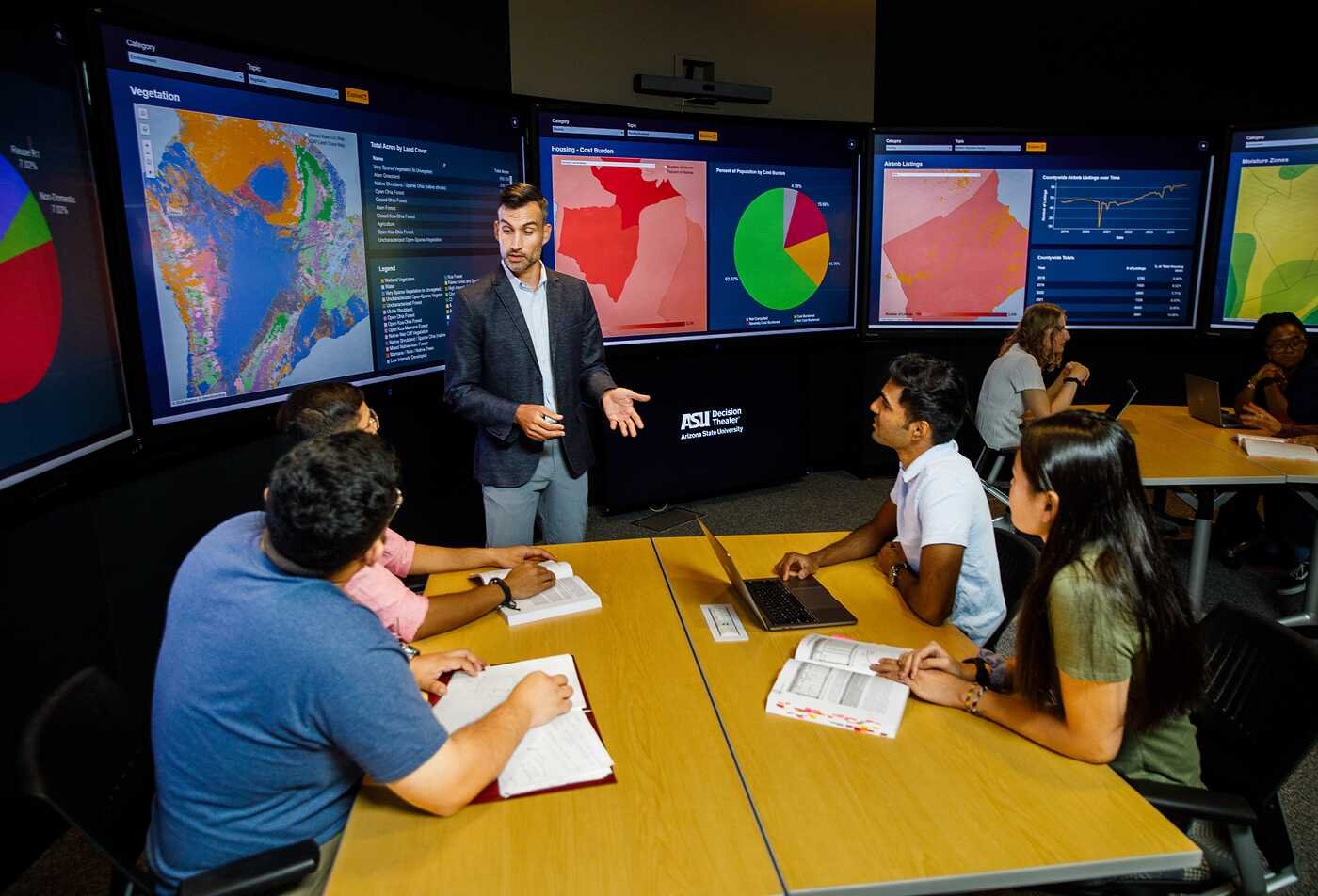
You'll also have the chance to work with ASU's Decision Theater, where technical tools bring different groups together to build data-driven models and shared understanding. Through this collaboration, you'll learn to manage the convergence of multiple disciplines, datasets, ways of knowing and approaches to governance.
The complex systems science master's builds skills in theoretical foundations, modeling and critical thinking. You'll practice approaching hard problems by asking questions, analyzing data and working with others to create effective solutions.
Additional details
Beyond your coursework, you can tap into a range of opportunities through the Rob Walton College of Global Futures, along with hundreds of study abroad options and student organizations across the broader ASU community.
Curriculum
This graduate degree includes courses focused on a specialized topic, so you can advance your skills for further professional opportunities. Explore all courses below.
30 credit hours including the required applied project course (CAS 593)
Required Core (15 credit hours) Students choose two: Electives (9 credit hours) Culminating Experience (6 credit hours) Additional Curriculum Information
CAS 501 Fundamentals of Complex Systems Science: Evolution (3)
CAS 502 Fundamentals of Complex Systems Science: Computation (3)
CAS 503 Fundamentals of Complex Systems Science: Collectives (3)
CAS 520 Agent Based Modeling (3)
CAS 521 Methods for Complex Systems Science: Network Analysis (3)
CAS 522 Methods for Complex Systems Science: Dynamical Systems (3)
CAS 523 Methods for Complex Systems Science: Statistics and Dimensionality Reduction (3)
CAS 593 Applied Project (6)
The applied project is a modeling and research project in any of the applied or foundational areas of complex systems science. Students define this project with a faculty mentor and apply a selection of methods covered in the methods courses to a dataset. The applied project also involves the creation of a portfolio of student accomplishments.


Admission requirements
Here are the admission and application details
All students are required to meet general university admission requirements.
U.S. applicants (opens in new window) | International applicants (opens in new window) | English proficiency (opens in new window)
Applicants must fulfill the requirements of both the Graduate College and the Rob Walton College of Global Futures. Applicants must have earned a bachelor's or master's degree from a regionally accredited institution. Applicants must have a minimum cumulative GPA of 3.00 (scale is 4.00 = "A") in the last 60 hours of their first bachelor's degree program or a minimum cumulative GPA of 3.00 (scale is 4.00 = "A") in an applicable master's degree program. All applicants must submit: Additional Application Information
An applicant whose native language is not English must provide proof of English proficiency regardless of current residency.
Application deadlines
| Session | Modality | Deadline | Type |
|---|---|---|---|
| Session A/C | Online | 04/07 | Final* |
| Session | Modality | Deadline | Type |
|---|---|---|---|
| Session A/C | Online | 10/07 | Final* |
*A final deadline means that all applications and application materials must be received by Admission Services by the deadline date. Applications that are incomplete may not be considered after the final deadline. Applications that are submitted past the final deadline may not be considered.
Explore expanded study opportunities
Studying abroad is encouraged for graduate students. Nearly all of the Rob Walton College of Global Futures faculty-directed programs offer graduate credit. In addition, the Global Education Office offers more than 50 program opportunities, with programs on every continent.
Faculty-directed programs tend to be the best fit for graduate students; taking courses with ASU professors over the summer or during academic breaks offers students close mentorship and professional network growth in many fields of study while they earn ASU credit. Exchange program participation is also possible with careful planning.
Students can find programs specific to their interests on the Rob Walton College of Global Futures study abroad webpage, and additional opportunities and information on the ASU Global Education Office website. These sites also include additional information about applying for funding to support global travel.
Graduate students are also encouraged to apply for funding for international research, study and professional development through ASU's Lorraine W. Frank Office of National Scholarships Advisement.


Paying for college
Use our calculator to estimate your full-time or part-time tuition fees for this program prior to any financial aid. Keep in mind that most of our students receive financial aid, which can reduce out-of-pocket costs.
Get an estimateCareer opportunities
Careers this complex systems science master's degree prepares you for
Complex adaptive system concepts and methods serve as bridges between disciplines, providing a common language that enables the interdisciplinary collaborations necessary to come to grips with today's intellectual and societal challenges.
A complex systems approach gives graduates the ability to understand the interconnections within and between technological, economic, societal, biomedical and environmental systems. Graduates have gained advanced digital skills, such as modeling and network science. They are fluent in the language of complexity and have a solid foundation in the domain knowledge of existing academic disciplines. All of this gives them an edge in diverse careers in science, technology and data analytics, especially compared with peers in their field of study who lack such expertise.
Graduates in complex systems science can apply their skills in many areas and professions, and make a difference through innovative and creative methods. Possible career areas include:
- business intelligence analytics and data science
- consulting
- corporate social responsibility and sustainability
- data and microsystem engineering
- education
- environmental systems
- natural or health science management
- nongovernmental and nonprofit work
- policy-making in government and regulatory agencies
- research and development

Contact information
Use the contact information below to get in touch if you're a current student or have general questions.
Prospective students should fill out the Request for Information form.
School of Complex Adaptive Systems
|
ECA 100
CASSgrad@asu.edu
480-727-0478
Admission deadlines
Frequently asked questions about degree programs
Accelerated programs allow students the opportunity to expedite the completion of their degree.
Accelerated master's
These programs allow students to accelerate their studies to earn a bachelor's plus a master's degree in as few as five years (for some programs).
Each program has requirements students must meet to be eligible for consideration. Students typically receive approval to pursue the accelerated master's during the junior year of their bachelor's degree program. Interested students can learn about eligibility requirements and how to apply.
Concurrent degrees allow students to pursue their own personal or professional interests, earn two distinct degrees and receive two diplomas. To add a concurrent degree to your existing degree, work with your academic advisor.
Joint programs, or jointly conferred degrees, are offered by more than one college and provide opportunities for students to take advantage of the academic strengths of two academic units. Upon graduation, students are awarded one degree and one diploma conferred by two colleges.
ASU adds new programs to Degree Search frequently. Come back often and look for the "New Programs" option.
ASU Online offers programs in an entirely online format with multiple enrollment sessions throughout the year. See https://asuonline.asu.edu/ for more information.
The Western Regional Graduate Program (WRGP) provides a reduced tuition rate to non-resident graduate students who qualify. Visit the WRGP/WICHE webpage for more information: https://graduate.asu.edu/wiche.
