

Design (Experience Design), MSD
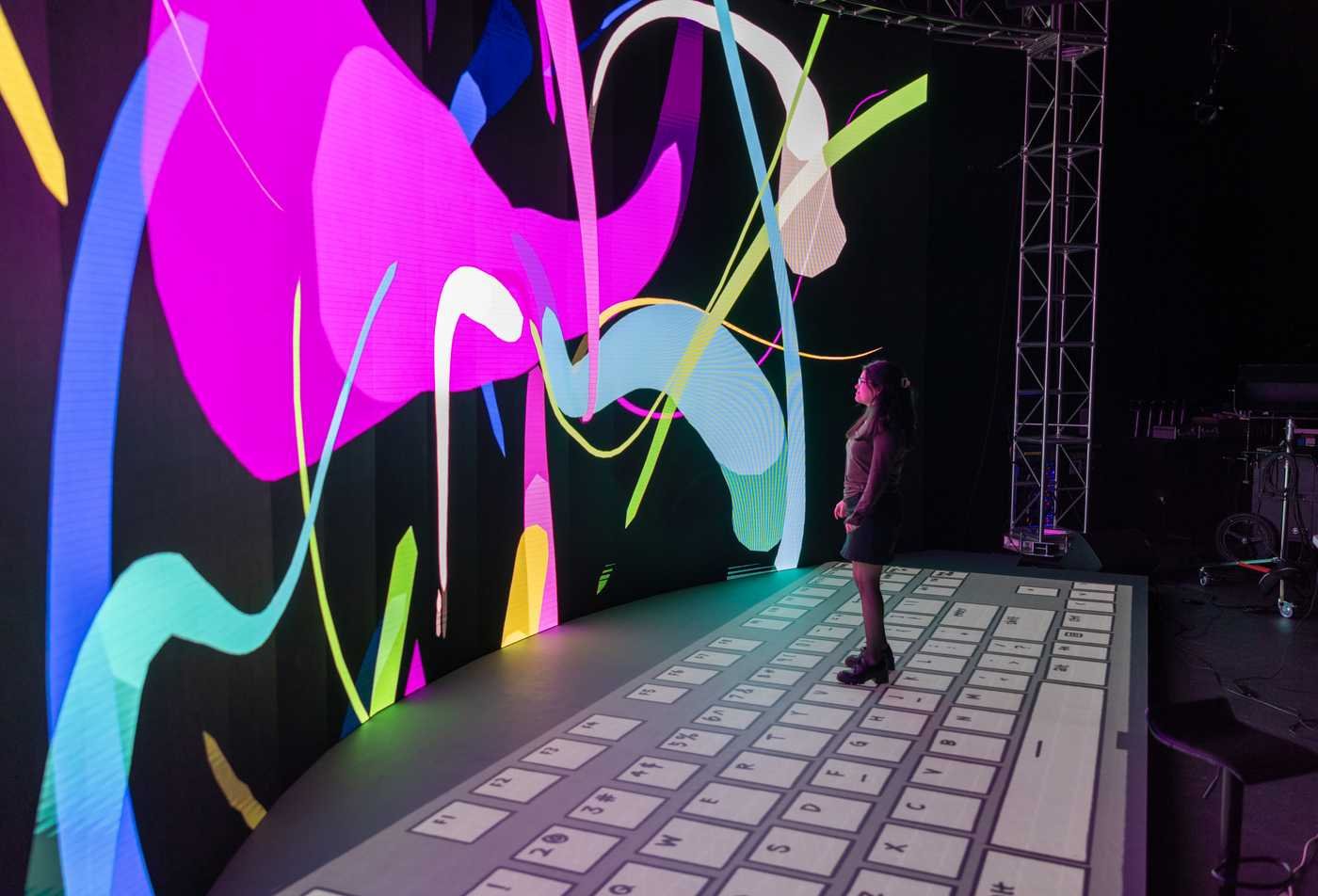
Learn to design all kinds of experiences, including games, extended and virtual realities, interactive environments, themed entertainment, and other forms of immersive storytelling in this engaging, cross-disciplinary program. By working collaboratively with peers and faculty members, you can transform research into creative, world-building projects that have public impact.
Quick facts


Credits
Additional facts
STEM-OPT extension eligible: No
International students (F1), this program is not eligible for the STEM-OPT extension.
Accreditation
Accredited by the Higher Learning Commission.
This program is not currently accepting applications.


Degree description
In the Master of Science in Design program with a concentration in experience design, you focus on design practices for virtual experiences in extended reality technologies, including environmental design, programmatic in both real and virtual universes, rapid prototyping, storytelling and world-building. This program is distinct among emerging media programs with its application of these technologies and practices in socially engaged and transdisciplinary modalities. You learn to take tools that evolved primarily from and for entertainment and applies them to the modeling of authentic challenges and futures.
You develop human-centered design methods to improve user experience using theories and concepts from cognition and psychology, in addition to developing the ability to manage projects, work effectively in teams, and transform research into creative and technological products.
Curriculum
This graduate degree includes courses focused on a specialized topic, so you can advance your skills for further professional opportunities. Explore all courses below.
36 credit hours and a thesis, or
36 credit hours including the required applied project course (DSC 593)
Required Core (3 credit hours) Concentration (9 credit hours) Research Methods (3 credit hours) Electives (11 credit hours) Other Requirements (4 credit hours) Culminating Experience (6 credit hours) Additional Curriculum Information For other requirements, students must complete a minimum of four credit hours of faculty-led research (DSC 592), individualized instruction (DSC 590), the design and implementation of public programs (HDA 580), or an internship (DSC 584).
DSC 501 Qualitative Research in Design (3)
DSC 550 Prototyping Futures (3)
DSC 551 Immersive Experience Design I (3)
HDA 581 Emerging Media Colloquium (3)
DSC 500 Research Methods (3)
DSC 584 Internship (4) or
DSC 590 Reading and Conference (4) or
DSC 592 Research (4) or
HDA 580 Practicum (4) or
DSC 593 Applied Project (6) or
DSC 599 Thesis (6)
In the concentration coursework, HDA 581 should be taken three times for one credit hour.


What you'll learn
The following learning outcomes highlight some of the knowledge and skills you'll develop to support your future success.
- Evaluate human experience needs and wants using immersive concepts and technologies.
- Apply their understanding and practice of design, storytelling, and worldbuilding through a design proposal that utilizes immersive technologies to addressing problems, challenges and obstacles.
- Develop solutions to real-world challenges through collaboration with interdisciplinary, transdisciplinary, and multi-stakeholder partners.
 Evaluate human experience needs and wants using immersive concepts and technologies.
Admission requirements
Here are the admission and application details
All students are required to meet general university admission requirements.
U.S. applicants (opens in new window) | International applicants (opens in new window) | English proficiency (opens in new window)
Applicants must fulfill the requirements of both the Graduate College and the Herberger Institute for Design and the Arts. Applicants are eligible to apply to the program if they have earned a bachelor's or master's degree in design and media arts or a related field from a regionally accredited institution. Applicants must have a minimum cumulative GPA of 3.00 (scale is 4.00 = "A") in the last 60 hours of their first bachelor's degree program, or a minimum cumulative GPA of 3.00 (scale is 4.00 = "A") in an applicable master's degree program. All applicants must submit: Additional Application Information The Design School requires that the letter of intent, portfolio, resume or CV, and contact information for professional references be submitted via SlideRoom in addition to the Graduate College application requirements. https://asudesign.slideroom.com/#/Login In the letter of intent, applicants should express their intention to apply to the program by outlining the reasons for their application, their motivation for pursuing the program and their future goals in the field, briefly touching upon their background, experiences and qualifications that make them a suitable candidate for the program. The portfolio should be a curated collection of a candidate's design works, projects and creations to visually represent the applicant's skills, creativity, design sensibilities and ability to conceptualize, innovate and effectively communicate design ideas. Applicants must submit contact information for two professional references. These can come from current and past faculty members, professional mentors, supervisors, or community leaders and elders. Admission to the program is selective. Admission cannot be deferred. Students must enroll in the semester for which they are admitted; otherwise, they need to go through the entire application process again for the year for which they are applying.
An applicant whose native language is not English must provide proof of English proficiency regardless of their current residency.
Application deadlines
| Session | Modality | Deadline | Type |
|---|---|---|---|
| Session A/C | In Person | 06/30 | Final* |
| Session A/C | In Person | 01/15 | Priority* |
| Session | Modality | Deadline | Type |
|---|---|---|---|
| Session A/C | In Person | 11/15 | Final* |
| Session A/C | In Person | 09/15 | Priority* |
*A final deadline means that all applications and application materials must be received by Admission Services by the deadline date. Applications that are incomplete may not be considered after the final deadline. Applications that are submitted past the final deadline may not be considered.
*A priority deadline means that applications submitted and completed before the priority deadline will receive priority consideration. Applications submitted after the priority deadlines will be reviewed in the order in which they were completed and on a space-available basis. An application is complete after all materials are received by Admission Services.
Explore expanded study opportunities
This program allows you to obtain both a bachelor's and a master's degree in as little as five years. As a high-achieving student, accelerated bachelor's plus master's degree programs are designed for you to share undergraduate coursework with graduate coursework to accelerate completion of your master's degree. These programs feature the same high-quality curriculum taught by ASU's world-renowned faculty.
This program is offered as an accelerated bachelor's plus master's degree with:
Approval to pursue the accelerated master's is typically granted during the junior year of your bachelor's degree program. If you are interested, you can learn more about eligibility requirements and how to apply.


Paying for college
Use our calculator to estimate your full-time or part-time tuition fees for this program prior to any financial aid. Keep in mind that most of our students receive financial aid, which can reduce out-of-pocket costs.
Get an estimateCareer opportunities
Graduates of this program are well prepared for careers in a variety of fields related to the application of immersive experience design and extended reality technologies and practices.
Virtual and augmented reality have practical and popular applications in entertainment, gaming, workforce development and research, but graduates of this program also had direct experience with the application of these tools to other areas that can expand their available pathways: architecture, interior design, urban planning, health care and education, among others. They are ideally suited for the rapidly changing climate of this field.
Career opportunities include:
- architects and interior designers
- experience designers
- film and video editors
- graphic designers
- mobile developers
- software developers
- 3D modelers and visualizers
- web developers

Contact information
Use the contact information below to get in touch if you're a current student or have general questions.
Prospective students should fill out the Request for Information form.
The Design School
|
CDN 162
MIXStudents@asu.edu
480-965-3436
Admission deadlines
Frequently asked questions about degree programs
Accelerated programs allow students the opportunity to expedite the completion of their degree.
Accelerated master's
These programs allow students to accelerate their studies to earn a bachelor's plus a master's degree in as few as five years (for some programs).
Each program has requirements students must meet to be eligible for consideration. Students typically receive approval to pursue the accelerated master's during the junior year of their bachelor's degree program. Interested students can learn about eligibility requirements and how to apply.
Concurrent degrees allow students to pursue their own personal or professional interests, earn two distinct degrees and receive two diplomas. To add a concurrent degree to your existing degree, work with your academic advisor.
Joint programs, or jointly conferred degrees, are offered by more than one college and provide opportunities for students to take advantage of the academic strengths of two academic units. Upon graduation, students are awarded one degree and one diploma conferred by two colleges.
ASU adds new programs to Degree Search frequently. Come back often and look for the "New Programs" option.
ASU Online offers programs in an entirely online format with multiple enrollment sessions throughout the year. See https://asuonline.asu.edu/ for more information.
The Western Regional Graduate Program (WRGP) provides a reduced tuition rate to non-resident graduate students who qualify. Visit the WRGP/WICHE webpage for more information: https://graduate.asu.edu/wiche.
