

Geological Sciences, MS
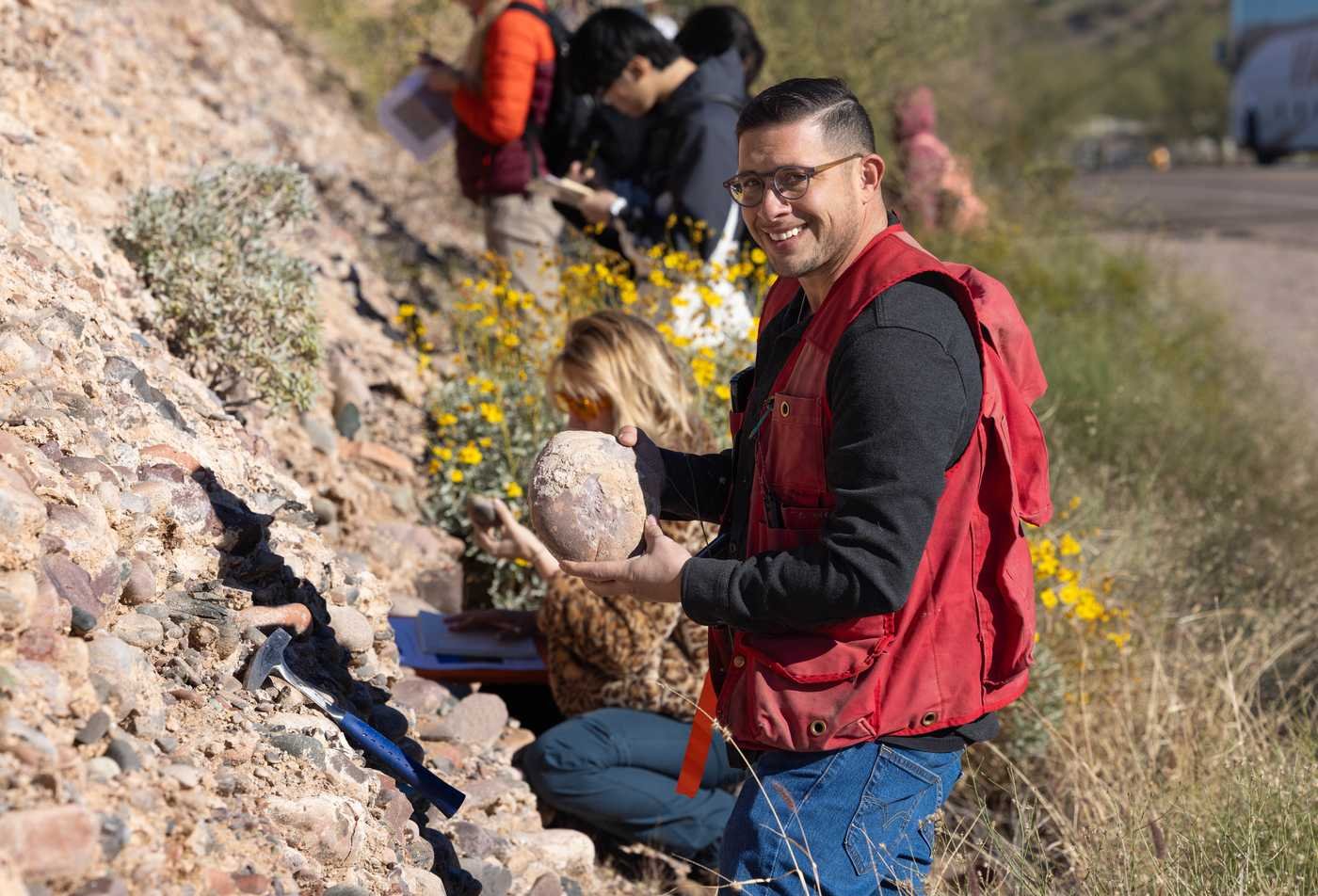
Partner with professional faculty on NASA- and NSF-funded projects. Work in state-of-the-art labs and in the field across any of the seven continents. Build portable skills that extend far beyond geoscience, including field and lab methods, coding, numerical modeling and data analysis.
Quick facts

Locations


Credits
Additional facts
STEM-OPT extension eligible: Yes
International students (F1) can extend U.S. work experience by 24 months.
Accreditation
Accredited by the Higher Learning Commission.


Degree description
Geological Sciences master's description
In the Master of Science program in geological sciences, you receive fundamental graduate training in geology. You are encouraged to cross subject boundaries and pursue new understandings of Earth and the solar system.
Why study geological sciences at ASU?
Geology at ASU lives inside the School of Earth and Space Exploration, where you study Earth alongside planetary scientists, astrophysicists and instrument builders. You develop both classic field and lab expertise and modern computational, modeling, and remote-sensing skills, a combination that opens doors in research, industry, and government, and prepares you for doctoral study.
Additional details
As part of the SESE graduate community, based largely on the Tempe campus, you gain access to analytical labs, field programs and the Marston Exploration Theater. You have access to state-of-the-art analytical laboratories for geochemistry, mineralogy and petrology. You also take part in the SESE colloquium, field trips and research symposia.
Curriculum
This graduate degree includes courses focused on a specialized topic, so you can advance your skills for further professional opportunities. Explore all courses below.
30 credit hours and a thesis
Required Core (1 credit hour) Electives or Research (22 credit hours) Other Requirements (1 credit hour) Culminating Experience (6 credit hours) Additional Curriculum Information
SES 502 Exploring SESE Research (1)
SES 501 SESE Colloquium (1)
SES 599 Thesis (6)
Substitutions for courses listed as Other Requirements may be made with department approval.


What you'll learn
The following learning outcomes highlight some of the knowledge and skills you'll develop to support your future success.
- Critically analyze and apply advanced geological concepts to investigate processes shaping the interior and surface of the Earth and other planetary bodies by evaluating geoscientific data and producing original research.
- Apply advanced analytical, modeling, and/or field-based methods to investigate geological and/or planetary problems.
- Conduct independent research that demonstrates the ability to critically evaluate geological and/or planetary data.
 Critically analyze and apply advanced geological concepts to investigate processes shaping the interior and surface of the Earth and other planetary bodies by evaluating geoscientific data and producing original research.
Admission requirements
Here are the admission and application details
All students are required to meet general university admission requirements.
U.S. applicants (opens in new window) | International applicants (opens in new window) | English proficiency (opens in new window)
Applicants must fulfill the requirements of both the Graduate College and The College of Liberal Arts and Sciences. Applicants are eligible to apply to the program if they have earned a bachelor's degree in any field from a regionally accredited institution. Applicants must have a minimum cumulative GPA of 3.00 (scale is 4.00 = "A") in the last 60 hours of their first bachelor's degree program. All applicants must submit: Additional Application Information Applicants should see the program website for application deadlines.
An applicant whose native language is not English must provide proof of English proficiency regardless of their current residency.
Application deadlines
| Session | Modality | Deadline | Type |
|---|---|---|---|
| Session A/C | In Person | 12/01 | Priority* |
| Session | Modality | Deadline | Type |
|---|---|---|---|
| Session A/C | In Person | 10/01 | Priority* |
*A priority deadline means that applications submitted and completed before the priority deadline will receive priority consideration. Applications submitted after the priority deadlines will be reviewed in the order in which they were completed and on a space-available basis. An application is complete after all materials are received by Admission Services.


Paying for college
Use our calculator to estimate your full-time or part-time tuition fees for this program prior to any financial aid. Keep in mind that most of our students receive financial aid, which can reduce out-of-pocket costs.
Get an estimateCareer opportunities
Careers this geological sciences master's degree prepares you for
Graduates are prepared for further graduate study or for careers in geochemistry, field geology, geomorphology, structure and tectonics, mineralogy and petrology, geophysics, planetary geology, hydrology, volcanology, Earth observation and remote sensing, and related areas, including geoscience education.
Professionals with expertise in geological sciences are in high demand across sectors and industries, including remote sensing, natural resource management, data science, economic geology (oil and mining industries), environmental consulting, hazard and risk assessment, geophysics and planetary science. Coding and numerical modeling skills translate across many domains, even beyond geosciences. Skills in the measurement and analysis of data related to the physics, chemistry and structures of the Earth and of planetary systems are valuable to businesses and institutions that rely on data-driven strategies to interact with the planet and explore beyond Earth.
Career examples include:
- data scientist
- environmental consultant
- GIS or mapping specialist
- materials analyst
- planetary scientist
- research geologist
Some students go on to doctoral programs in the field of geological sciences.

Contact information
Use the contact information below to get in touch if you're a current student or have general questions.
Prospective students should fill out the Request for Information form.
School of Earth and Space Exploration
|
ISTB4 795
sese-prospectivegrads@asu.edu
480-965-5081
Frequently asked questions about degree programs
Accelerated programs allow students the opportunity to expedite the completion of their degree.
Accelerated master's
These programs allow students to accelerate their studies to earn a bachelor's plus a master's degree in as few as five years (for some programs).
Each program has requirements students must meet to be eligible for consideration. Students typically receive approval to pursue the accelerated master's during the junior year of their bachelor's degree program. Interested students can learn about eligibility requirements and how to apply.
Concurrent degrees allow students to pursue their own personal or professional interests, earn two distinct degrees and receive two diplomas. To add a concurrent degree to your existing degree, work with your academic advisor.
Joint programs, or jointly conferred degrees, are offered by more than one college and provide opportunities for students to take advantage of the academic strengths of two academic units. Upon graduation, students are awarded one degree and one diploma conferred by two colleges.
ASU adds new programs to Degree Search frequently. Come back often and look for the "New Programs" option.
ASU Online offers programs in an entirely online format with multiple enrollment sessions throughout the year. See https://asuonline.asu.edu/ for more information.
The Western Regional Graduate Program (WRGP) provides a reduced tuition rate to non-resident graduate students who qualify. Visit the WRGP/WICHE webpage for more information: https://graduate.asu.edu/wiche.
