

Sustainable Food Systems, MS
Access to fresh, healthy food is a basic human need, and feeding a growing population of nine billion is a real challenge in the face of climate change. With this degree, you can help create a more just and resilient global future for food.
Quick facts

Locations


Credits
Additional facts
STEM-OPT extension eligible: No
International students (F1), this program is not eligible for the STEM-OPT extension.
Accreditation
Accredited by the Higher Learning Commission.


Degree description
The Master of Science in sustainable food systems is a research-oriented degree program in which you develop an understanding of present-day health, agriculture and environmental policy; develop strategies to lead policy discussions; interact with a network of food and agriculture policy leaders and mentors; and apply your knowledge and skills to address problems related to food and food systems.
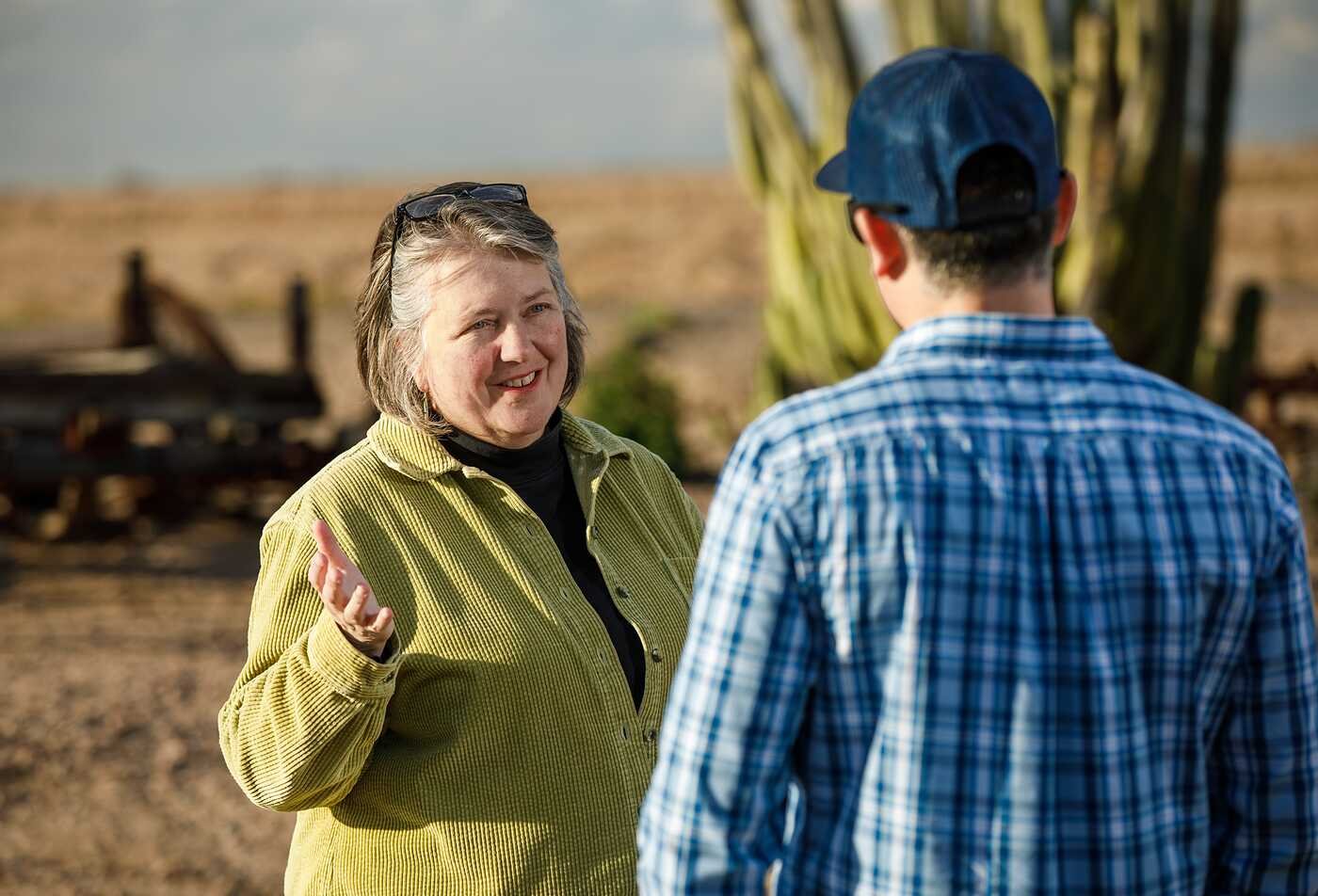
The program includes two week-long experiences for you to engage in food systems. The first is in Arizona. There, you have the opportunity to talk with and learn from farmers, ranchers and supply chain businesses about how food and agriculture policies and programs impact their operations. The second is a seminar in Washington, D.C, where you gain knowledge of leadership theories, develop leadership skills and engage in conversation with influential food policy leaders from a variety of sectors.
As a graduate of the program, you'll be able to employ solutions-based thinking and a dynamic systems framework to create the inclusive, diverse and resilient food systems of the future.
Curriculum
This graduate degree includes courses focused on a specialized topic, so you can advance your skills for further professional opportunities. Explore all courses below.
30 credit hours including the required capstone course (SFS 596)
Required Core (21 credit hours) Electives (6 credit hours) Culminating Experience (3 credit hours)
SFS 560 Tools and Tactics for Food Policy Change (3)
SFS 561 Food and Farm Immersion Experience (2)
SFS 562 Managing Natural Resources for Food Production (3)
SFS 563 Applied Food Policy Immersion Experience (2)
SFS 564 American Agriculture in the Global Context (2)
SFS 565 Research Methods and Analysis (3)
SFS 566 Applied Research Project (3)
SOS 509 Leading Sustainability Transitions (3)
SFS 596 Capstone (3)


Admission requirements
Here are the admission and application details
All students are required to meet general university admission requirements.
U.S. applicants (opens in new window) | International applicants (opens in new window) | English proficiency (opens in new window)
Applicants must fulfill the requirements of both the Graduate College and the Rob Walton College of Global Futures. Applicants are eligible to apply to the program if they have earned a bachelor's or master's degree in any field from a regionally accredited institution. Applicants must have a minimum cumulative GPA of 3.00 (scale is 4.00 = "A") in the last 60 hours of their first bachelor's degree program or a minimum cumulative GPA of 3.00 (scale is 4.00 = "A") in an applicable master's degree program. Applicants are required to submit: Additional Application Information The statement of intent should not exceed 600 words and applicants must explain the goals they intend to achieve through their plan of study at the Rob Walton College of Global Futures, specifically in the field of sustainable food systems. Applicants should elaborate on key research questions they wish to address or problems they wish to solve as part of their plan of study. Finally, applicants should describe how their background will contribute to their success in the program. Letters of recommendation must be from two people who can attest to the applicant's academic and professional achievements. At least one letter should be academic in nature.
An applicant whose native language is not English must provide proof of English proficiency regardless of their current residency.
Application deadlines
| Session | Modality | Deadline | Type |
|---|---|---|---|
| Session A/C | Online | 07/31 | Final* |
*A final deadline means that all applications and application materials must be received by Admission Services by the deadline date. Applications that are incomplete may not be considered after the final deadline. Applications that are submitted past the final deadline may not be considered.
Explore expanded study opportunities
This program allows you to obtain both a bachelor's and a master's degree in as little as five years. As a high-achieving student, accelerated bachelor's plus master's degree programs are designed for you to share undergraduate coursework with graduate coursework to accelerate completion of your master's degree. These programs feature the same high-quality curriculum taught by ASU's world-renowned faculty.
This program is offered as an accelerated bachelor's plus master's degree with:
Approval to pursue the accelerated master's is typically granted during the junior year of your bachelor's degree program. If you are interested, you can learn more about eligibility requirements and how to apply.
Studying abroad is encouraged for graduate students. Nearly all of the Rob Walton College of Global Futures faculty-directed programs offer graduate credit. In addition, the Global Education Office offers more than 50 program opportunities, with programs on every continent.
Faculty-directed programs tend to be the best fit for graduate students; taking courses with ASU professors over the summer or during academic breaks offers students close mentorship and professional network growth in many fields of study while they earn ASU credit. Exchange program participation is also possible with careful planning.
Students can find programs specific to their interests on the Rob Walton College of Global Futures study abroad webpage, and additional opportunities and information on the ASU Global Education Office website. These sites also include additional information about applying for funding to support global travel.
Graduate students are also encouraged to apply for funding for international research, study and professional development through ASU's Lorraine W. Frank Office of National Scholarships Advisement.


Paying for college
Use our calculator to estimate your full-time or part-time tuition fees for this program prior to any financial aid. Keep in mind that most of our students receive financial aid, which can reduce out-of-pocket costs.
Get an estimateCareer opportunities
The MS program is designed to prepare future leaders in food policy. Its affiliation with the Swette Center for Sustainable Food Systems connects students and graduates to networks in the public, private and nonprofit sectors. Students can explore alumni employment data for career insights on theRob Walton College of Global Futures employment data page.
Graduates can use their training in sustainable food systems to advance their career in the food and agriculture sector. Career opportunities include:
- chief sustainability officer
- food policy analyst
- policy director
- senior advisor for sustainable food systems
- sustainability manager

Contact information
Use the contact information below to get in touch if you're a current student or have general questions.
Prospective students should fill out the Request for Information form.
School of Sustainability
|
WCPH 3rd
FoodSystemsGrad@asu.edu
480-727-6963
Admission deadlines
Frequently asked questions about degree programs
Accelerated programs allow students the opportunity to expedite the completion of their degree.
Accelerated master's
These programs allow students to accelerate their studies to earn a bachelor's plus a master's degree in as few as five years (for some programs).
Each program has requirements students must meet to be eligible for consideration. Students typically receive approval to pursue the accelerated master's during the junior year of their bachelor's degree program. Interested students can learn about eligibility requirements and how to apply.
Concurrent degrees allow students to pursue their own personal or professional interests, earn two distinct degrees and receive two diplomas. To add a concurrent degree to your existing degree, work with your academic advisor.
Joint programs, or jointly conferred degrees, are offered by more than one college and provide opportunities for students to take advantage of the academic strengths of two academic units. Upon graduation, students are awarded one degree and one diploma conferred by two colleges.
ASU adds new programs to Degree Search frequently. Come back often and look for the "New Programs" option.
ASU Online offers programs in an entirely online format with multiple enrollment sessions throughout the year. See https://asuonline.asu.edu/ for more information.
The Western Regional Graduate Program (WRGP) provides a reduced tuition rate to non-resident graduate students who qualify. Visit the WRGP/WICHE webpage for more information: https://graduate.asu.edu/wiche.
