

Environmental and Resource Management, Minor
Tackle environmental challenges by balancing conservation, protection and sustainable development. Apply concepts through field experiences and project-based coursework, then carry those skills into an increasingly eco-conscious job market.
Quick facts

Locations


Credits
Additional facts
Accreditation
Accredited by the Higher Learning Commission.


Minor description
Environmental and Resource Management minor description
In the minor program in environmental and resource management, you receive a thorough introduction to environmental regulations and key environmental management issues, such as the provision of clean, potable water; wastewater treatment; solid and hazardous waste management; and remediation technologies for polluted soils, groundwater and air. You learn to apply basic science and engineering principles to solving problems that significantly impact human health and ecosystems.
This program is a valuable addition to majors that focus on environmental issues, whether from a technical or a policy perspective. The courses form a coherent whole and demonstrate the connections among science, engineering, public policy, management and the law.
Why earn an environmental and resource management minor at ASU?
This minor centers on sustainable resource management, teaching you to weigh environmental protection against economic development, regulatory demands and responsible resource use, capabilities that are valued across a wide range of industries.
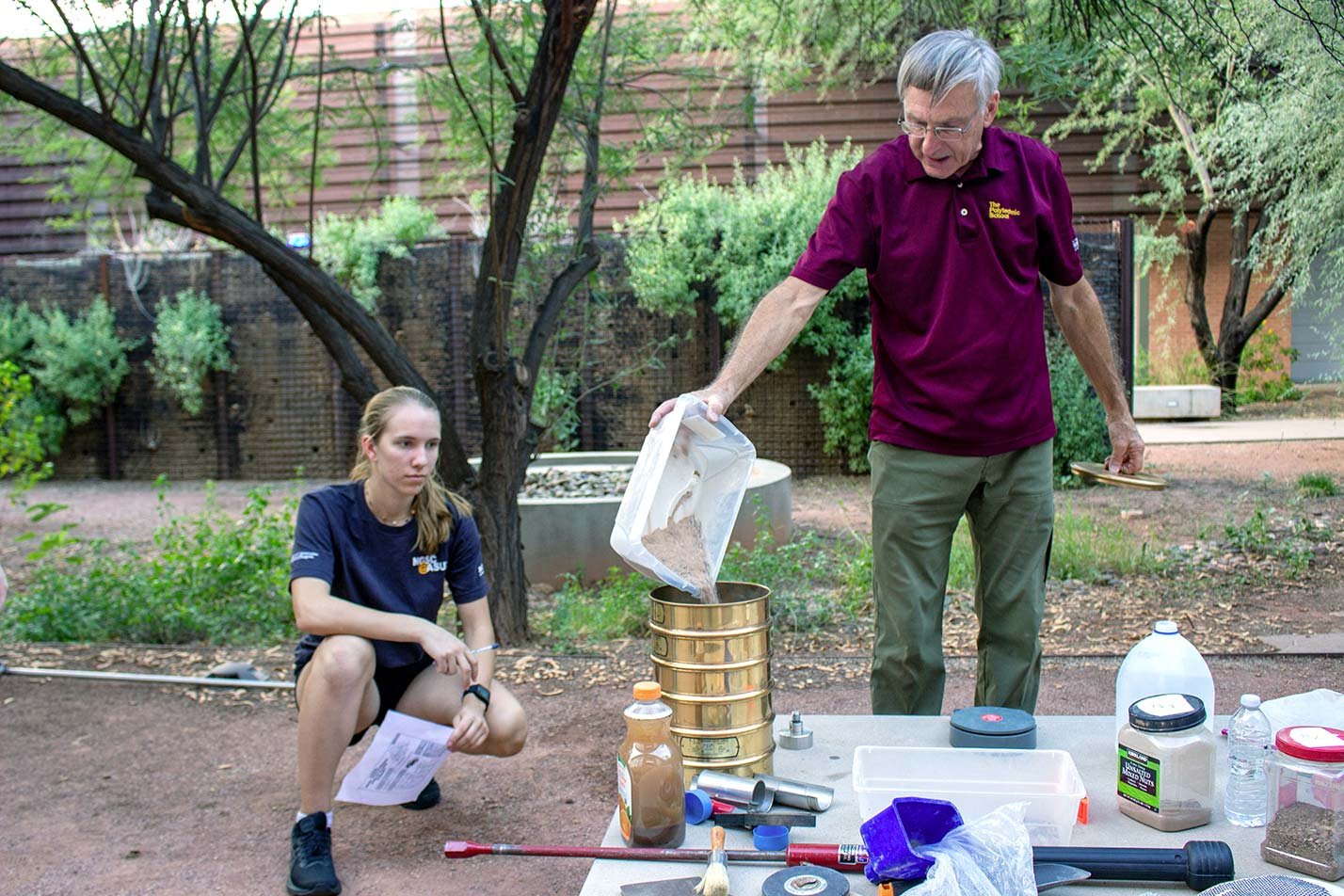
You benefit from the Polytechnic School's emphasis on experiential learning, applied research and industry engagement, connecting classroom concepts to real environmental challenges.
Courses
This undergraduate minor includes courses focused on a specialized topic, so you can advance your skills for further professional opportunities. Explore all courses below:
2026-2027 Catalog Year
The minor requires 18 credit hours. A "C" minimum is required for all courses in the minor, although students must maintain a 3.00 GPA in the post-baccalaureate certificate program.
| Requirement | Minimum grade | Credit hours |
|---|---|---|
|
The minor requires completion of four core courses (12 credit hours) and two elective courses (six credit hours) for a total of 18 credit hours. At least 12 credit hours must be completed in residency at ASU. Courses must be completed with a grade of "C" (2.00 on a 4.00 scale) or higher. |
||
|
ERM 201 Environmental Management
3 credit hours
Minimum
grade:C
|
C | 3 |
|
ERM 203 Environmental Regulations
3 credit hours
Minimum
grade:C
|
C | 3 |
|
ERM 302 Water and Wastewater Treatment Technology
3 credit hours
Minimum
grade:C
|
C | 3 |
|
ERM 401 Hazardous Waste Management
3 credit hours
Minimum
grade:C
|
C | 3 |
|
6 credit hours
Minimum
grade:C
|
C | 6 |
|
Prerequisite courses may be needed in order to complete the requirements of this minor.
|


Enrollment requirements
GPA Requirement: 2.00
Incompatible Majors: BS in environmental and resource management
Other Enrollment Requirements: Interested students must have at least sophomore status.
Current ASU undergraduate students may pursue a minor and have it recognized on their ASU transcript at graduation. Minor requirements appear on the degree audit once the minor is added. Certain major and minor combinations may be deemed inappropriate by the college or department of either the major program or the minor. Courses taken for the minor may not count toward both the major and minor.
Here are the admission and application details


Paying for college
Use our calculator to estimate your full-time or part-time tuition fees for this program prior to any financial aid. Keep in mind that most of our students receive financial aid, which can reduce out-of-pocket costs.
Get an estimateCareer opportunities
Careers this environmental and resource management minor prepares you for
Minor programs enable students to develop additional competencies that complement the marketable knowledge and skills they acquire in their majors. Graduates with the skills gained in this minor are in high demand and can find work in industry, governmental management and regulatory agencies, and policymaking organizations.

Contact information
Use the contact information below to get in touch if you're a current student or have general questions.
Environmental and Resource Management
|
WANER 240
polyadvising@asu.edu
480-727-1874
Frequently asked questions about degree programs
Accelerated programs allow students the opportunity to expedite the completion of their degree.
Accelerated master's
These programs allow students to accelerate their studies to earn a bachelor's plus a master's degree in as few as five years (for some programs).
Each program has requirements students must meet to be eligible for consideration. Students typically receive approval to pursue the accelerated master's during the junior year of their bachelor's degree program. Interested students can learn about eligibility requirements and how to apply.
Concurrent degrees allow students to pursue their own personal or professional interests, earn two distinct degrees and receive two diplomas. To add a concurrent degree to your existing degree, work with your academic advisor.
Joint programs, or jointly conferred degrees, are offered by more than one college and provide opportunities for students to take advantage of the academic strengths of two academic units. Upon graduation, students are awarded one degree and one diploma conferred by two colleges.
ASU adds new programs to Degree Search frequently. Come back often and look for the "New Programs" option.
ASU Online offers programs in an entirely online format with multiple enrollment sessions throughout the year. See https://asuonline.asu.edu/ for more information.
