

Chemistry, Minor
Choose an upper-division focus that fits your goals, either a biochemistry and physical chemistry track or an advanced physical chemistry track. Then develop hands-on laboratory skills through in-person experimental coursework.
Quick facts

Locations


Credits
Additional facts
Accreditation
Accredited by the Higher Learning Commission.


Chemistry minor description
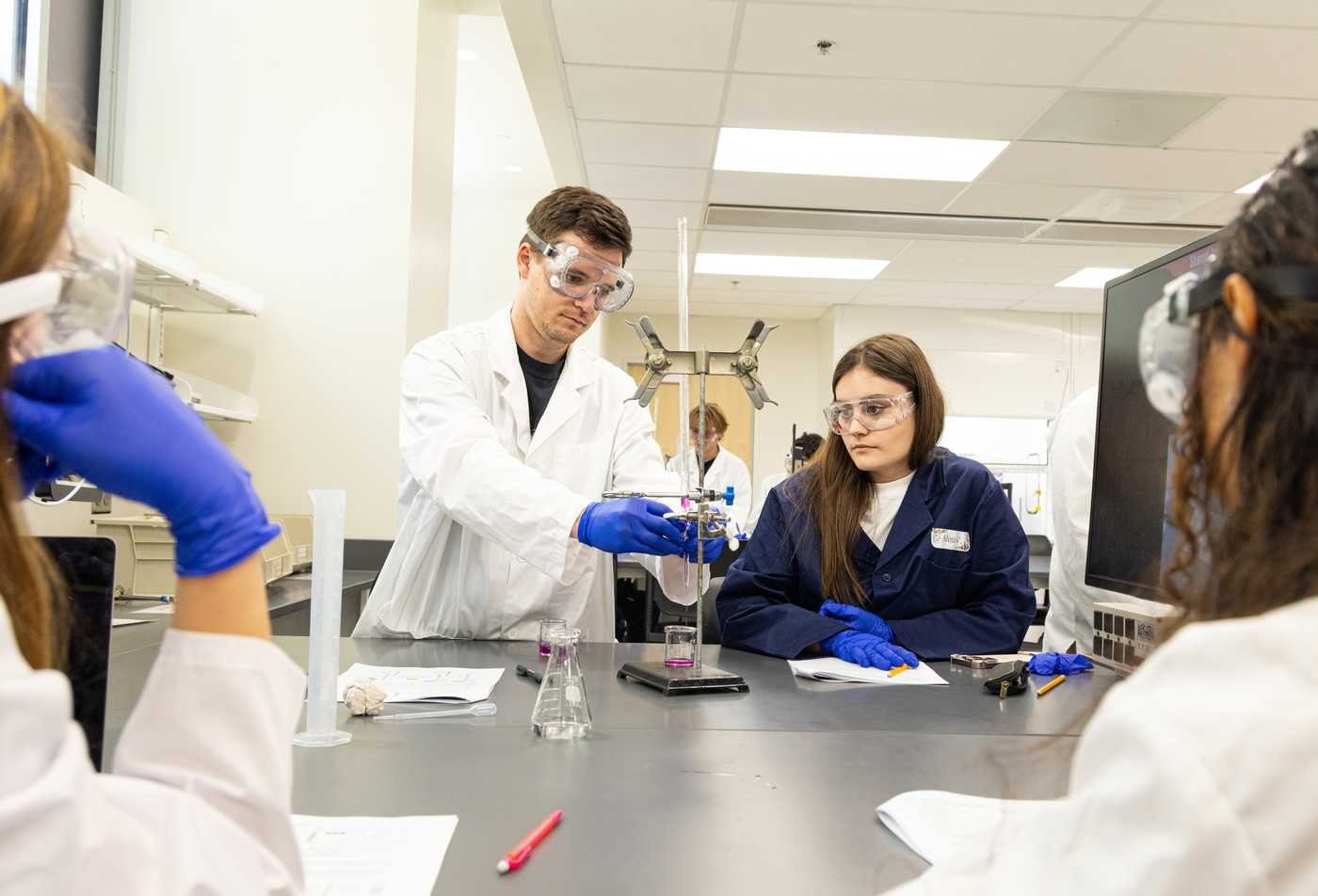
The chemistry minor program gives you a solid grounding in the basics of chemistry to complement your major. It's especially appropriate if your major is in the various disciplines of physics, materials science, geology, engineering and life sciences.
Why earn a chemistry minor at ASU?
Housed in ASU's School of Molecular Sciences, the chemistry minor treats the field as a modern, interdisciplinary science tied to medicine, materials, energy and data-rich laboratory work. You study under the same faculty who teach ASU's full chemistry degree programs, gaining access to their research expertise and rigorous coursework that reaches far past a surface introduction.
Additional details
Within the School of Molecular Sciences, you can join organizations built specifically for chemistry and biochemistry students, including the Student Affiliates of the American Chemical Society and the Women in Biochemistry Club. Getting involved is a great way to make friends, find study partners and connect with faculty outside the classroom, while research opportunities, internships and online student communities help you build experience beyond your coursework.
Courses
This undergraduate minor includes courses focused on a specialized topic, so you can advance your skills for further professional opportunities. Explore all courses below:
2026-2027 Catalog Year
| Requirement | Minimum grade | Credit hours |
|---|---|---|
|
The minor in chemistry requires 28 credit hours, of which 12 credit hours must be upper-division. A minimum of six upper-division credit hours must be completed through The College of Liberal Arts and Sciences. When selecting courses, the college offering the course can be identified by viewing the course details in Class Search. Only courses completed with a grade of "C" (2.00 on a scale of 4.00) or better may be applied toward the minor requirements. |
||
|
CHM 113 General Chemistry I
(SCIT)
OR CHM 117 General Chemistry for Majors I (SCIT) AND CHM 111 General Chemistry Laboratory for Majors I (SCIT)
4 credit hours
Minimum
grade:C
|
C | 4 |
|
CHM 116 General Chemistry II
(SCIT)
OR CHM 118 General Chemistry for Majors II (SCIT) AND CHM 112 General Chemistry Laboratory for Majors II (SCIT)
4 credit hours
Minimum
grade:C
|
C | 4 |
|
CHM 233 General Organic Chemistry I
3 credit hours
Minimum
grade:C
|
C | 3 |
|
CHM 237 General Organic Chemistry Laboratory I
1 credit hours
Minimum
grade:C
|
C | 1 |
|
CHM 234 General Organic Chemistry II
3 credit hours
Minimum
grade:C
|
C | 3 |
|
CHM 238 General Organic Chemistry Laboratory II
1 credit hours
Minimum
grade:C
|
C | 1 |
|
CHM 325 Analytical Chemistry
3 credit hours
Minimum
grade:C
|
C | 3 |
|
CHM 326 Advanced Analytical Chemistry Laboratory
1 credit hours
Minimum
grade:C
|
C | 1 |
|
Choose either the Biochemistry/Physical Focus or the Advanced Physical Chemistry Focus for the additional 8 credit hours.
8 credit hours
Minimum
grade:C
|
C | 8 |
|
Prerequisite courses may be needed in order to complete the requirements of this minor.
|
||
|
Courses in this program may only be offered once per academic year. See academic advisor for details.
|




Enrollment requirements
GPA Requirement: 2.00
Incompatible Majors: BS in applied biological sciences (all concentrations); BS and BA in biochemistry; BS in biochemistry (medicinal chemistry); BS and BA in chemistry; BS in chemistry (environmental chemistry); BS in forensic science; BS in health sciences (preprofessional); BS in nutrition; BS in nutrition (human nutrition); BS in medical studies; BS in neuroscience
Other Enrollment Requirements: None
Current ASU undergraduate students may pursue a minor and have it recognized on their ASU transcript at graduation. Minor requirements appear on the degree audit once the minor is added. Certain major and minor combinations may be deemed inappropriate by the college or department of either the major program or the minor. Courses taken for the minor may not count toward both the major and minor.
Here are the admission and application details


Paying for college
Use our calculator to estimate your full-time or part-time tuition fees for this program prior to any financial aid. Keep in mind that most of our students receive financial aid, which can reduce out-of-pocket costs.
Get an estimateCareer opportunities
Careers this chemistry minor prepares you for
Minor programs enable students to develop additional competencies that complement the marketable knowledge and skills they acquire in their majors.
A chemistry minor can benefit graduates pursuing careers in chemical, electronics, manufacturing and environmental industries, and in national research and forensic labs.


Contact information
Use the contact information below to get in touch if you're a current student or have general questions.
School of Molecular Sciences
|
PSC 116
SMSadvising@asu.edu
480-965-7667
Frequently asked questions about degree programs
Accelerated programs allow students the opportunity to expedite the completion of their degree.
Accelerated master's
These programs allow students to accelerate their studies to earn a bachelor's plus a master's degree in as few as five years (for some programs).
Each program has requirements students must meet to be eligible for consideration. Students typically receive approval to pursue the accelerated master's during the junior year of their bachelor's degree program. Interested students can learn about eligibility requirements and how to apply.
Concurrent degrees allow students to pursue their own personal or professional interests, earn two distinct degrees and receive two diplomas. To add a concurrent degree to your existing degree, work with your academic advisor.
Joint programs, or jointly conferred degrees, are offered by more than one college and provide opportunities for students to take advantage of the academic strengths of two academic units. Upon graduation, students are awarded one degree and one diploma conferred by two colleges.
ASU adds new programs to Degree Search frequently. Come back often and look for the "New Programs" option.
ASU Online offers programs in an entirely online format with multiple enrollment sessions throughout the year. See https://asuonline.asu.edu/ for more information.
