
Russian and East European Studies, Certificate
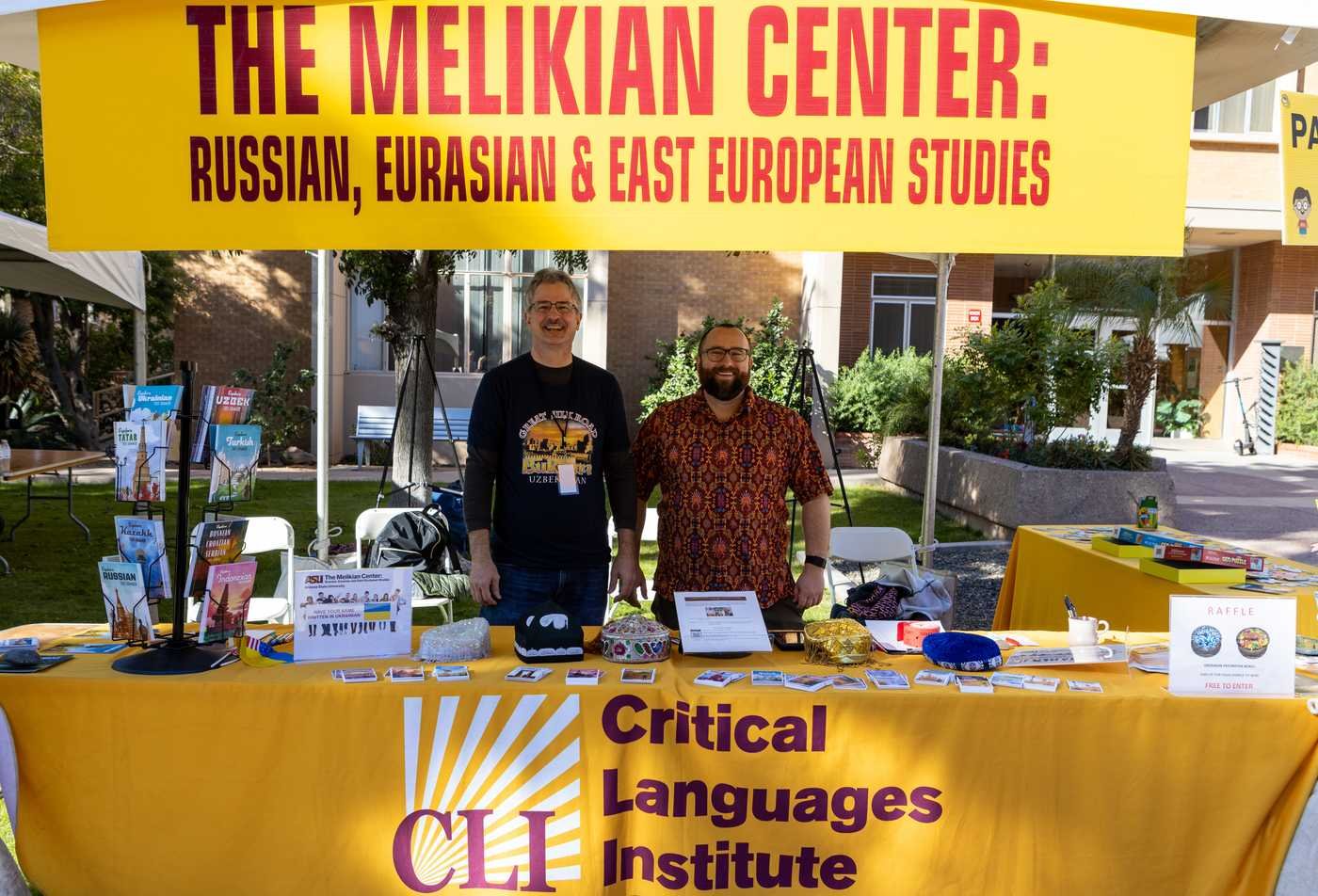
Explore Russia and Eastern Europe firsthand through the Melikian Center's Critical Languages Institute, where this certificate opens numerous opportunities to study abroad and immerse yourself in the languages and cultures shaping the region.
Quick facts

Locations


Credits
Additional facts
Accreditation
Accredited by the Higher Learning Commission.


Certificate description
Russian and East European Studies undergraduate certificate description
The certificate program in Russian and East European studies encourages you to develop competency in Russian or another East European or Eurasian language as well as the culture and politics of the region.
Coursework leading to the certificate is offered by outstanding faculty members in diverse fields of study, including architecture, economics, film studies, geography, history, international business, literature, music, political science and religious studies.
A one-credit, student-led capstone course is completed in your junior or senior year; with the support of an advisor, you can write a research paper on the Russian and East European studies topic of your choice, prepare a writing sample or a graduate school application, or work on a creative project.
If you have a major in any school or department, you may pursue this certificate and develop a personalized plan of study in cooperation with an advisor at The Melikian Center: Russian, Eurasian and East European Studies.
Why earn a Russian and east European studies undergraduate certificate at ASU?
The Critical Languages Institute at ASU's The Melikian Center is a national training institute for less commonly taught languages. It offers summer intensive courses and study abroad programs around the world. Languages taught include Albanian, Armenian, Bosnian/Serbian/Croatian, Kazakh, Macedonian, Persian/Farsi, Polish, Russian, Tatar, Turkish, Ukrainian and Uzbek.
Courses
This undergraduate certificate includes courses focused on a specialized topic, so you can advance your skills for further professional opportunities. Explore all courses below:
2026-2027 Catalog Year
The certificate requires 19 credit hours. A "C" minimum is required for all courses in the certificate, although students must maintain a 3.00 GPA in the post-baccalaureate certificate program.
| Requirement | Minimum grade | Credit hours |
|---|---|---|
|
The certificate in Russian and East European studies requires 19 credit hours, of which 13 credit hours must be upper-division. A minimum of six upper-division credit hours must be completed through The College of Liberal Arts and Sciences. When selecting courses, the college offering the course can be identified by viewing the course details in Class Search. Only courses completed with a grade of "C" (2.00 on a scale of 4.00) or better may be applied toward the certificate requirements. |
||
|
Students may complete one language course from BCS, PLC, ROM, or RUS, or they may complete the Albanian, Armenian, BCMS (Bosnian/Croatian/Montenegrin/Serbian), Kazakh, Macedonian, Persian, Polish, Russian, Tatar, Turkish, Ukrainian, and Uzbek courses offered by the Critical Languages Institute to fulfill the language requirement. Native speakers of a language must complete credit hours in a different language to fulfill this requirement.
3 - 5 credit hours
Minimum
grade:C
|
C | 3 - 5 |
|
Other HST 304 topics appropriate to the certificate's regional focus may be used with the approval of the certificate advisor. Courses shown that are not used to satisfy a Required Certificate Elective may be used as an Area-Related Elective.
6 credit hours
Minimum
grade:C
|
C | 6 |
|
SLC 429
/
CEL 429 Topic: Politics & Culture in European Short Fiction
or
SLC 598 Topic: Politics and Culture in European Short Fiction
or
ENG 429 Topic: Politics & Culture in European Short Fiction
Other HST 304 topics appropriate to the certificate's regional focus may be used with the approval of the certificate advisor. Courses shown that are not used to satisfy a Required Certificate Elective may be used as an Area-Related Elective.
3 credit hours
Minimum
grade:C
|
C | 3 |
|
SLC 429
/
CEL 429 Topic: Politics & Culture in European Short Fiction
or
SLC 598 Topic: Politics and Culture in European Short Fiction
or
ENG 429 Topic: Politics & Culture in European Short Fiction
Other HST 304 topics appropriate to the certificate's regional focus may be used with the approval of the certificate advisor. Courses shown that are not used to satisfy a Required Certificate Elective may be used as an Area-Related Elective. Arranged honors theses and upper-division colloquia with Melikian Center faculty affiliates may also be used toward this requirement.
6 credit hours
Minimum
grade:C
|
C | 6 |
|
LIA 485 REES Certificate Capstone
In their junior or senior year, students will complete the one-credit REES Certificate Capstone. This can be in the form of a reading course offered by the Melikian Center or a project chosen in cooperation with a Melikian Center faculty affiliate. The project should represent an extended, research-based focus on some dimension of the region's languages, cultures, religions, histories, and/or politics. It may take the form of an extended research paper, honors thesis, translation project, research assistantship or internship. Other courses may be used with the approval of the certificate advisor.
1 credit hours
Minimum
grade:C
|
C | 1 |
|
Prerequisite courses may be needed in order to complete the requirements of this certificate.
|


What you'll learn
The following learning outcomes highlight some of the knowledge and skills you'll develop to support your future success.
- Analyze or examine a current or historical issue in Russia, Eastern Europe or Eurasia; utilize and evaluate sources of information on the issue; and construct an argument or produce a creative project about the issue.
- Demonstrate a high degree of competency, defined as the ability to use language in real world situations in a manner deemed appropriate by native speakers and instructors of the language, in a REES language.
 Analyze or examine a current or historical issue in Russia, Eastern Europe or Eurasia; utilize and evaluate sources of information on the issue; and construct an argument or produce a creative project about the issue.
Enrollment requirements
A student pursuing an undergraduate certificate must be enrolled as a degree-seeking student at ASU. Undergraduate certificates are not awarded before the award of an undergraduate degree. A student already holding an undergraduate degree may pursue an undergraduate certificate as a nondegree-seeking graduate student.
Here are the admission and application details
Explore expanded study opportunities
The Critical Languages Institute at ASU's The Melikian Center is a national training institute for less commonly taught languages. It offers summer intensive courses and study abroad programs around the world. Languages taught include Albanian, Armenian, Bosnian/Serbian/Croatian, Kazakh, Macedonian, Persian/Farsi, Polish, Russian, Tatar, Turkish, Ukrainian and Uzbek.
Specially designed, synchronous online summer intensive programs prepare students --- even beginners --- to function competently in the language they are learning when they go abroad. Once overseas, students live the language as they participate in family life, join sports and gaming clubs, sing in choirs, participate in neighborhood projects, and otherwise actively immerse themselves in the culture.


Paying for college
Use our calculator to estimate your full-time or part-time tuition fees for this program prior to any financial aid. Keep in mind that most of our students receive financial aid, which can reduce out-of-pocket costs.
Get an estimateCareer opportunities
Careers this Russian and east European studies undergraduate certificate prepares you for
Students who complete this certificate program enhance their prospects for highly competitive study abroad scholarships, including Fulbright, Boren and Critical Language Scholarship Program, and for selective graduate programs. Certificate holders may also qualify for distinct internships and entry-level government employment opportunities at agencies such as the U.S. Department of State and the National Security Agency.

Contact information
Use the contact information below to get in touch if you're a current student or have general questions.
Historical, Philosophical & Religious Studies, Sch
|
DH 247
melikiancenter@asu.edu
480-965-4188
Frequently asked questions about degree programs
Accelerated programs allow students the opportunity to expedite the completion of their degree.
Accelerated master's
These programs allow students to accelerate their studies to earn a bachelor's plus a master's degree in as few as five years (for some programs).
Each program has requirements students must meet to be eligible for consideration. Students typically receive approval to pursue the accelerated master's during the junior year of their bachelor's degree program. Interested students can learn about eligibility requirements and how to apply.
Concurrent degrees allow students to pursue their own personal or professional interests, earn two distinct degrees and receive two diplomas. To add a concurrent degree to your existing degree, work with your academic advisor.
Joint programs, or jointly conferred degrees, are offered by more than one college and provide opportunities for students to take advantage of the academic strengths of two academic units. Upon graduation, students are awarded one degree and one diploma conferred by two colleges.
ASU adds new programs to Degree Search frequently. Come back often and look for the "New Programs" option.
ASU Online offers programs in an entirely online format with multiple enrollment sessions throughout the year. See https://asuonline.asu.edu/ for more information.
